PLAN Before You’ll Need a Plan

Compass-seaLWhile involved in ‘the challenging waters’ of career transition, the same chaotic, jobless, trying times are very productive times. Don’t waste them by floundering with lack of focus and direction, falling into the dark, depressive attitude of distractions and, worst of all, inaction…

When we are employed, we tend to function under the guidance of our employer’s business plan, or, more specifically, our job description. Our ‘routine’ is defined by:

  • Personal accountability to a labyrinth of responsibilities, some structured— some not structured at all—but all contributing to productive work activities…
  • We create productivity and efficiency with our sense of time management…
  • And as ‘top talent’ professionals, we often take initiative, make process improvements, and contribute to the Company’s growth.

This Week’s Session, Thursday, August 2nd, 8:45 AM, at The Egg and I Restaurant in Addison… Developing Your Personal Marketing Plan


chalk1So, why not recreate all that with OUR OWN PLAN, a Personal Marketing Plan, to move toward job satisfaction, commitment, and appropriate compensation, for the rest of our careers… including any current, short term job search?   But, before looking at what such a Personal Marketing Plan would look like, let’s review the PREPARATION Portion of the 12-step Process Model (on the left).

If an individual is under-employed, seeking a change, or actually unemployed, they must be visible to potential employers who are seeking their services. Creating this visibility is strategic, personal market planning and execution—in can be marketability without rejection!

And, employed or not, Modify and improve your Personal Market Plan’s implementation model as needed… As you move through your career transition or ‘job search campaign,’ make adjustments as you would a business model.

BRANDING Yourself In The OTHER Job Market

Your “market-tested” RESUME TEMPLATE can now serve as the basis of your correspondence templates. Become familiar with the AUTO TEXT and MAIL MERGE applications within MS Word to create efficiency in the editing of your templates to meet the needs of specific opportunities that you are marketing yourself to.

Now it is REALLY beginning to feel like YOU are market-ready… but, THE Careerpilot encourages you to be totally prepared before you do. Let’s not forget to be prepared for the digital face of the job market…

 LinkedIn Task#1: INITIATING YOUR SOCIAL MEDIA STRATEGY

The Careerpilot’s high TECH-HIGH TOUCH philosophy comes into play with the explosive growth of using social networks to recruit top talent and for job seekers to build relationships, meet new contacts, and market themselves. While the Internet provides many choices, diving into the virtual meet-and-greet can represent a real challenge.

Which one is worthy of your start-up investment: learning curve time and actual ROI of your efforts… Where to begin? The Careerpilot encourages a choice that reasonably assures one’s confidentiality, has a multitude of useful applications, and can serve as your focal point of networking decisions… LinkedIn.

INITIAL RESEARCH:  To Create Focus

 Make a concerted effort to research trends and target organizations of geographies, industries, and functions that interest you. Access market research reports, the Internet, your own network… start with the resources with which you are already comfortable. Develop your research awareness and abilities.

Begin to assemble your INITIAL Target Organization List.  Start your list of companies and industries that are attractive to you. Your targets are companies that utilize the functionality and RESULTS that you can bring to the table. A great start is to consider industrial trends in the marketplace that point to an organization’s need for your services.

 INITIAL CONTACTS List

 Make a list of coworkers, bosses, customers, suppliers, associates, external consultants, etc. Make a list of family, extended family, friends, relatives of friends, neighbors, people you know from special interest groups like bowling or bridge, church contacts, former classmates or alumni, and professionals like your doctor, dentist, or hair stylist.

Elements of a GREAT Resume: Your Positioning Statement

bob-maher-4587-editWhat YOU Do Best, and are motivated to do for a future employer… What DO you do best? What are your strongest transferable skills? Discovering your “pattern of success and satisfaction” is your goal, here, in Achieving CareerFIT. Your ability to express the collection of your functional strengths will measure your marketability.

However… A lesson that the marketplace has taught us over the years is that realistic requirements and accurate job descriptions are elusive, moving targets. That said, a GREAT resume, then, is a journey that SMART professionals choose to pursue for the rest of their career… NOT a destination sought before entering the marketplace during active job search.


NEXT Session: Thursday, July 26th…Developing In Sync Personal Marketing Collaterals, HAVING a GREAT Resume!


chalk1Look at your “journey” like your own personal marketing LABORATORY—one in which you’ll spend significant time during active job search in order to develop an effective communication strategy and tactics. Be your own best Marketing Department… know the time tested, vital ingredients and components that you will need for your laboratory…

CONTACT INFORMATION

This component sounds like a ‘no brainer;’ however, even this basic requires some experimentation and choices. A great resume is written for the reader, not to please the writer.  So, even YOUR NAME requires that you select exactly how you want your reader to access your background and credentials… Their ‘offer criteria.’   Your choices…

  • FULL legal name, including recognized credentials… or,
  • Your full name, including middle name or initial… or,
  • The name that you are usually called, potentially including… or,
  • A nickname (a rare choice for a professional resume)

YOUR MAILING ADDRESS also requires some choice. Does it potentially create a discrimination based on your ‘neighborhood’ or geography? In today’s digital world of recruitment, your actual residential address is rarely used until hired. So, you may elect to use just your city and state… or simply use your email address as a preferred method of contact.

When actually hired, however, be prepared to give your employer more complete and accurate mailing address.

Make a choice of which PHONE NUMBER you want to use. The traditional stacking of home, office, and cell numbers gives you little control. Rather, select the single best number to reach you during normal working hours— remember your are writing for the reader. An alternative is using a number that can be forwarded to you, where-EVER you are… and when-EVER…BE ACCESSIBLE!

…And what about your EMAIL ADDRESS? Please be aware that while your family and friends might enjoy communicating with you at ‘happymom@aol.com,’ you will be more professionally received at ‘JaneDoe1@gmail.com,’ one of your FREE alternatives.

Google allows you to forward from an email address that you can create to present a more professional “brand” for yourself—for example… ‘QCPro@printmedia.com,’ an opportunity to express your positioning and targeted industry. You’ll want to create and control for accessibility during active job-search.

You thought these were going to be EASY choices?  Remember that, in the digital world of recruitment, your contact information is your best ‘unique identifier’ of who you are in the mega-databases out there.

 POSITIONING STATEMENT

When a reader makes it through your contact information, in the top portion of a great resume they must have a clear picture of what you are motivated to do for them. In today’s digital world of optimized screening and recruitment, THE Careerpilot encourages a very simple, straight-forward approach—one example…

                        DISTRICT OPERATIONS MANAGER                                                                        Business Development | Operations Analysis | Project Management | Process Improvement | Quality Assurance | Staff Development

Note the ‘defining keywords.’  It would be ideal to edit your resume template to precisely FIT each job or employment opportunity’s title and requirements. However, this professional’s more generic template might start with the following positioning…

GENERAL MANAGEMENT

Strategic Planning… Operational Analysis… Manufacturing Process Improvement… Multi-unit Leadership… Customer Service

ACHIEVING CareerFIT

chalk1In order to market yourself, you must first know yourself.  The job search process is essentially a highly personalized marketing process.  The process starts with your candid self-assessment, which allows you to gain a thorough and workable understanding of who you are in product marketing terms.

When a Company looks for qualified employees, they seek functional evidence that demonstrates a job seeker’s ability to perform to their best expectations… JOB REQUIREMENTS represent the HR screening process!


THIS Week’s Session:  Achieving CareerFIT, an exploration of the product analysis phase of Personal Market Planning


bob-maher-4587-editEspecially if you are starting a resume “from scratch”, or if you are truly unsettled on next steps along your career path, this becomes a necessary first step in the process.
What YOU Do Best, and are motivated to do for a future employer…

What do you do best?  What are your strongest transferable skills?  Think broadly in terms of managerial and technical/ functional strengths involved in what you have to offer.  Discovering your “pattern of success and satisfaction” is your goal, here.

Your ability to express the collection of your functional strengths will measure your marketability.  This collection of keywords and their supportive evidence creates your communication strategy, the basis of your value proposition.

The old “round peg in a round role” theory of career planning is dysfunctional.  In the typical professional environment today, job descriptions are changing faster than ever before to keep up with the challenges of an economy in transition. In the traditional job market, job seekers are the sellers and their potential employers are the buyers.  The commodity is JOBs and the competition is fierce.

In The OTHER Job Market, buyers and sellers hold equal responsibility for the recruitment process.  The commodity is available, productive WORK… When employers have a need for someone to fulfill a specific role, often the most desired candidates are employed individuals with the credentials they seek.  Thus the employer must sell their Company to potential employees in the marketplace in order to attract the best of the lot.  Once identified, they simply select their choice and buy their services.

Seize control of such challenges.   Understand the nature of FIT.  

Surviving and Thriving in “The Sea of Unwashed Faces”

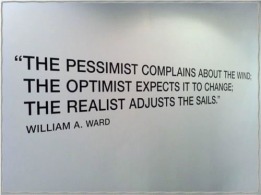
AjustDaSailsIn the traditional marketplace, potential employers seem to have the upper hand… but like the ol’ half full glass of water, remember that from the employer’s view available top talent seems like a sea of unwashed faces, too.

So what is it that the job seeker can control to make THEIR face stand out…network to and interview with the true decision maker… BE the chosen one?


THIS Week’s Session: Thursday, July 12th at The Egg and I…

Embracing The OTHER Job Market


bob-maher-4587-editStanding-out in the “sea of unwashed faces” becomes the simple matter of adjusting ones sales when in the challenging waters of career transition.

Create an expectation of who you are and what you can do for your next employer by clearly positioning and targeting your collateral materials, both written and verbal.  When stating your career objective, clearly state your appropriate work and make an offer of your services.

Here are some tips on becoming a valued partner…

Walk the talk.  Nothing speaks louder than results…. From the recruitment perspective, the best indicator of one’s potential for success is one’s prior experience and results gained.  A partner helps others within the organization achieve their goals. And results require actions, not just words. The better the results you get, the more likely you are to be invited on to ‘the team.’

Deep knowledge. You must have a true understanding of every aspect of the business, how all the moving parts work together, the obstacles ahead, and intimate knowledge of the competition in the marketplace. In other words, you’ve done your homework and understand your potential employer’s need.  And you must be able to articulate your understanding to anyone involved in the decision-making process in a manner that demonstrates that you truly get it.

Two of the many ways of accomplishing this image are to…

  1. Keep a file of relevant articles to share with key decision-makers, take advantage of the approaches that email and social media have to offer… create and maintain top-of-mind awareness.
  2. Further, create a set of ‘white papers’ that express, from your knowledge and experience, your perspective on relevant issues to your Profession or industry of choice.

Listen well. Everyone loves to feel that they have been heard and understood. One attribute of leadership is being known as a good listener. And if you can reiterate and articulate what has been said, you will be valued as a partner in the decision-making process.

Remember, as a job seeker, NETWORKING is your way to share knowledge, ‘branding’ yourself as a valued resource.  It is also your best source of confirming the subjective information you seek to supplement your research of factual information about a potential employer.

Big picture thinking. Having a strategic vision requires you to see all areas of the business, internal and external.   This is a valuable trait well beyond the C-suite.  If you only have a deep understanding of one area, you are more likely to be tactical in your decisions, rather than strategic.

You must be able to foresee problems from the stakeholders’ perspective in order to offer the most highly valued and comprehensive solutions.

Tying all of this together, the best way to be treated like a valued partner is to act like one. The more you demonstrate your value, the more you will become recognized as the new go-to person in the organization.

Banging On The Screen Door

chalk1The term “third party recruiter” goes by many names, including contingency agencies, executive search firms, retained search firms, employment agencies, headhunters, recruiters, and temp agencies.  These all fall under the umbrella of the “staffing industry.”

Contingency Agencies are paid by the company after the agency’s candidate is hired…their sourcing process is a paperwork mill.

Retained Search Firms custom locates candidates for a company and are paid upfront or on a progress basis (retained basis). Their sourcing process is often more focused and conducted on a more personal level.

Employment Agencies are contracted by companies to find candidates for temporary or permanent positions.  Often their sourcing and screening activity is conducted in parallel to Corporate recruiting efforts.

Temporary (Temp) Agencies find candidates to fill temporary jobs and “temp to perm” positions.  This includes the Lease2Perm TECHNICAL firms.


This week’s session, Thursday, June 28th at The Egg and I: An exploration of the third-party world of recruitment


bob-maher-4587-editIn embracing The OTHER Job Market, a successful professional seeking their next appropriate employment will learn the technique of using the services of a third party recruiter.  Our goal is to understand their world, from THEIR viewpoint, in order to optimize the effectiveness of our efforts looking for work.

HOMEWORK for this week’s session…

The American Staffing Association (ASA)

TEXAS specific statistics… Third-party recruitment statistics in Texas

As promised here is more of my list of things you should take into consideration when working with staffing agencies.

  1. Working with a staffing agency does not guarantee placement in a job.  It’s one of many techniques to use in your job search.
  2. Staffing agencies do the initial screening, saving the employer time and money… they are an extension of the employer’s recruiting and screening process.
  3. Don’t abdicate the tasks of the job search to a recruiter who is busy working with lots of job seekers.
  4. Reducing or stopping your networking efforts once you start using a staffing agency is a huge mistake.
  5. Approximately 79 percent of staffing employees work full-time according to the American Staffing Association (ASA).
  6. Recruiters have contacts in the business community which only extends your networking outreach.
  7. Employers that experience an unexpected increase in business may favor hiring temps before hiring permanent workers.
  8. Companies are using staffing agencies to “test drive” the performance of a temp before offering a permanent position.
  9. The ASA notes that 12 million Americans will work at some point during the course of the year in as a temp or contract employee.
  10. Temping is not a step down.  It’s money, connections, a resume gap stopper and an opportunity to get your foot in the door.
  11. Signing up with a staffing agency is usually quick and easy, much of which can be done online.
  12. While actual titles may vary, there are basically three functions within any one staffing firm: those that identify and bring in the actual job orders, those that identify and initially screen potential applicants, and those that administer the firm’s process.
  13. Network with your LinkedIn connections to learn more about the right staffing firms to use; use more than one agency. “Reach out” to at least two firms each week within your Personal Marketing Plan.
  14. Check the phone book or Internet for a list of staffing agencies; also use the Internet to find additional information…CAUTION: There is no directory of the ‘good ones.’ THAT is a matter of your personal relationship with them.
  15. Schedule an appointment with a staffing agency representative.  Dress to impress, show your smile and give a firm handshake.
  16. Make sure your resume has been professionally critiqued before you submit it to a staffing agency.

* more to follow *


The OTHER Job Market Has a Screen Door, Too!

Compass-seaLJust as in traditional job search, there are four avenues in to more efficient and productive job search: Classified advertising, third-party recruitment services, employer job postings (this trio can be addressed by using the Internet ‘job boards’), and personal contact networking.

One of the many keys to unlocking the screen door of The OTHER Job Market is to sieze control of the process and take actions like that of an equal partner in the recruitment process.


This week’s session, Thursday, June 28th at The Egg and I: An exploration of the third-party world of recruitment


bob-maher-4587-editIn embracing The OTHER Job Market, a successful professional seeking their next appropriate employment will learn the technique of using the services of a third party recruiter.  The term “third party recruiter” goes by many names including contingency agencies, executive search firms, retained search firms, employment agencies, headhunters, recruiters, and temp agencies.  These all fall under the umbrella of the “staffing industry.”

Contingency Agencies are paid by the company after the agency’s candidate is hired…their sourcing process is a paperwork mill.

Retained Search Firms custom locates candidates for a company and are paid upfront or on a progress basis (retained basis). Their sourcing process is often more focused and conducted on a more personal level.

Employment Agencies are contracted by companies to find candidates for temporary or permanent positions.  Often their sourcing and screening activity is conducted in parallel to Corporate recruiting efforts.

Temporary (Temp) Agencies find candidates to fill temporary jobs and “temp to perm” positions.  This includes the Lease2Perm TECHNICAL firms.

The number of temporary employees is growing and this trend is expected to continue.

TMI (Too Much Information)… The American Staffing Association (ASA)

TEXAS specific statistics… Third-party recruitment statistics in Texas

Temping can help you learn new skills and experience, build your network, open up options you had not previously considered and bridge employment gaps.  The goal is to get inside a company.  Here is my list of things you should take into consideration when working with staffing agencies.

  1. Some agencies have skills training to prepare employees for their assignments; others expect you to hit the ground running.
  2. Temp jobs can often be the answer when your cash reserves are running low.
  3. Temping can give you experience in careers you might not have otherwise thought of trying – without a long-term commitment.
  4. Having the flexibility from temping can work well for your job search and personal priorities.
  5. Signing up with a staffing agency is usually quick and easy, much of which can be done online.
  6. Approximately 79 percent of staffing employees work full-time according to the American Staffing Association (ASA).
  7. The ASA notes that 12 million Americans will work at some point during the course of the year in as a temp or contract employee.
  8. Temping is not a step down.  It’s money, connections, a resume gap stopper and an opportunity to get your foot in the door.

*MORE to follow*

Interview SKILL: Becoming a ‘Valued Partner’

Compass-seaLWhether you are an operations manager, an internal HR professional, senior finance executive, or a key player on the IT team—ANY experienced and valued professional job seeker—ALL and EVERYONE should want to become a ‘valued partner’ in the strategic and operational planning–as well as the execution–of their next employer. To become fully engaged, Everyone wants a voice in strategic decisions and to be included in ‘the conversation.’


THIS WEEK’s Session, Thursday, June 21st: Closing The Deal II, exploring and practicing interview tactics, including POST-OFFER Negotiation


chalk1To truly be included, you need to be invited. And you will only be invited if you are seen as absolutely essential to the TEAM.  Remember, team player and team leader CAN BE interchangeable terms.

Here are some tips on becoming a valued partner…

Walk the talk.  Nothing speaks louder than results…. From the recruitment perspective, the best indicator of one’s potential for success is one’s prior experience and results gained.  A partner helps others within the organization achieve their goals. And results require actions, not just words. The better the results you get, the more likely you are to be invited on to ‘the team.’

Deep knowledge... You must have a true understanding of ‘the bigger picture…’ how does your department fit into meeting organizational goals and objectives?  In other words, you’ve done your homework and understand your potential employer’s need.  And you must be able to articulate your understanding to anyone involved in the decision-making process in a manner that demonstrates that you truly get it.

Two of the many ways of accomplishing this image are to…

  1. Keep a file of relevant articles to share with key decision-makers, take advantage of the approaches that email and social media have to offer… create and maintain top-of-mind awareness.
  2. Further, create a set of ‘white papers’ that express, from your knowledge and experience, your perspective on relevant issues to your Profession or industry of choice.

 Listen well Everyone loves to feel that they have been heard and understood. One attribute of leadership is being known as a good listener. And if you can reiterate and articulate what has been said, you will be valued as a partner in the decision-making process.  Remember, the human brain takes IN information more efficiently than it can put out valued communication.

Communicate Like The LEADER You ARE 

Remember, as a job seeker, NETWORKING is your way to share knowledge, ‘branding’ yourself as a valued resource.  It is also your best source of confirming the subjective information you seek to supplement your research of factual information about a potential employer.


Big picture thinking Having a strategic vision requires you to see all areas of the business, internal and external.   This is a valuable trait well beyond the C-suite.

If you only have a deep understanding of one area, you are more likely to be tactical in your decisions, rather than strategic. You must be able to foresee problems from the stakeholders’ perspective in order to offer the most highly valued and comprehensive solutions.  Tying all of this together, the best way to be treated like a valued partner is to act like one.

The more you demonstrate your value, the more you will become recognized as the go-to person in the organization and you will be included and have a voice in the big strategic decisions.

YOUR Digital Footprint

REMEMBER Memorial DayThe Careerpilot’s high TECH-HIGH TOUCH philosophy comes into play with the explosive growth of business professionals using social networks to build relationships, meet new contacts, and market themselves.  While the Internet provides many choices, diving into the virtual meet-and-greet can represent a real challenge.  Which one is worthy of your start-up investment: learning curve time and actual ROI of your efforts…  Where to begin?


Bob is back and will be facilitating This Week‘s Session, Thursday, May 31st…                     A LinkedIn Primer: Task #2 and #3, a discussion of how to extend the reach of your contact network…extending your digital footprint


Pilot OnboardThe Careerpilot encourages a choice that reasonably assures one’s confidentiality, has a multitude of useful applications, and can serve as your focal point of networking decisions.

A terrific launching site for such an effort is LinkedIn. Developed specifically for business, the site doesn’t run the risk of blurring your professional life with your private one; and, it serves virtually every industry and profession.

Joining a network like LinkedIn is simple, but turning it into a powerful networking tool takes a bit of savvy. Here’s how to build a network, leveraging your available time… and put it all to work — without HIGH TECH, social-networking anxiety.

TASK #2  Build Your Network

Goal: Stay focused.  Only connect with others who share your professional interests or are related to those interests in a complementary way… and can help you meet your goals.  After you’ve created your profile, it’s time to begin to connect to others.

LinkedIn will allow you to search for people you know to see if they’re already members. But once you connect to someone, you can also look at the profiles of anyone they know, and in turn anyone those people know. Because of these three degrees of separation, your network can grow rapidly.

Before you begin connecting, decide who you want to connect to. LinkedIn suggests in its FAQ, “Only invite those you know and trust.” 

The 411 on “How Not to Be Connected”

If someone contacts you and you don’t want to form a connection with them, you don’t need to flatly reject them and worry about the attendant awkwardness. When looking at the invitation to connect, simply hit “Archive.” The other person does not receive a message saying their invitation has been rejected, and you don’t have to worry about unwanted invitations clogging up your inbox.

Likewise, if you find that an existing contact is blasting you with too much information or making overly aggressive requests for introductions and recommendations, LinkedIn will let you remove that person easily — and without the contact knowing they’re out of your network.

If only it were that easy in real life.

What’s Next?

  1. Check in on “Network Updates.” Found on your LinkedIn homepage, Network Updates are kind of like your Facebook news feed. Check these periodically for a quick snapshot of what your connections are up to and sharing. And, it’s a 2-way street: Your updates, including white papers you may choose to “publish,” go out to your network.
  2. Be identifiable. Find out who’s checking out your profile by allowing others to see who you are if you view theirs. When you click the information under “Who’s Viewed My Profile” on your profile page, you’ll be able to view users who have looked at your profile, stats on your profile’s number of views, and its appearances in search recently. To change this, go into your settings and click “See what others see when you’ve viewed their profile.”
  3. Export connections. Transfer your LinkedIn connections to another contact management system? LinkedIn enables you to easily export your connections. Just click on “Contacts,” “My Connections,” and then scroll down and click “Export Connections.” You have the option of either exporting as a .CSV or .VCF file.
  4. Leverage the power of LinkedIn Groups. Did you know that if you’re a member of the same group as another user, you can bypass the need to be a first degree connection in order to message them? In addition, group members are also able to view the profiles of other members of the same group without being connected. Join more groups to enable more messaging and profile viewership capabilities.
  5. Link your Twitter acct to LinkedIn. Share your LinkedIn status updates on Twitter, and vice versa. Learn how to connect your Twitter account in your “settings” area.

Yes, A GREAT Resume!

Compass-seaL

Your work in Achieving CareerFIT led you to the determination of your career objective, exactly what is the best next step for you in your career transition?  It also suggested strongly that you set your straw-man offer criteria to guide you in moving forwardKnowing what your next right employment  is.

This will help focus your actual search. With clarity in your positioning and targeting goals, you can write a great resume to convey “your story.”


Next Session, Thursday, May 3rd: In Sync Personal Marketing Collateral Materials


Your Personal Market Collateral

WRITTEN COLLATERAL…

  1.  A GREAT Resume that positions you clearly as a terrific FIT with your career objectives… and in today’s technologies, a database-friendly, asci version;
  2. A correspondence template package that consistently carries your communication strategy, your message… and in today’s technologies, a reformatted, text only version of your resume ready for email needs;
  3. A high impact, personal biography and/or NETWORKING PROFILE that you can lead with in your referral based networking strategies.

VERBAL COLLATERAL…

  1.  A well rehearsed “two minute commercial,” your answer to the most asked question during career transition, “Tell me about yourself.”
  2. Several, well though out, “elevator speeches,” examples that support your primary, positioning, key words. These are usually your representative accomplishments under the SUMMARY of your resume. (30 seconds to 1 minute)
  3. A succinct “qualification statement” that you can use as an introduction at networking events. (usually 20 – 30 seconds)
  4. An “exit statement” which explains your availability, to address the second most asked question during career transition.

Having your collaterals prepared and rehearsed prior to active personal marketing is central to your success and builds confidence.

Consistency in the delivery of your message is what creates memory… and frequency of your message helps you get there… strive for top-of-mind awareness where it relates to your candidacy.

Your personal marketing COMMUNICATION STRATEGY, your story, must be built around keywords and phrases that best describe your unique value proposition. These words come from your concerted self-assessment process. The challenge is matching the words that best describe your next right employment with the words that best describe a potential new employer’s needs.

A communication strategy that does not achieve that is doomed to otherwise controllable difficulties—and, worst…failure. So, understand that getting recruited involves two distinct elements…

  • Being screened for meeting a JOB’s requirements… a subjective process created by the potential employers of the marketplace. They set the bar HIGH, defined by functional experience, skill set, and knowledge standards so they don’t have to interview every JOB applicant.
  • Being selected by the hiring authority… another subjective process which now involves their assessment of a job-seeker’s FIT with their needs, including personality, work habits, and other ‘cultural’ standards. They cannot hire all qualified candidates. They must choose.

A job-seeker, then, can give themselves choices when they choose to embrace the OTHER Job Market. They improve their probability of success by nearly eliminating the pre-mature screening and rejection process.

Instead, the SMART job-seeker chooses to build relationships with potential employers first, researching attractive trends and targeted organizations in order to maximize probability of success, avoiding the HR-driven screening process to identify appropriate opportunities for securing their next right employment.

Your ‘Digital FOOTPRINT’

Your Career CompassSocial media is a great place to learn about and create a digital conversation with your market. Potential employers do not want to be talked-to, or worse yet sold-to on these platforms. Your followers want to know they have a place to come learn, to ask questions about things THEY care about, and to know they are being heard.


THIS Week’s session:  Thursday, March 15th… Turning OPPORTUNITIES into INTERVIEWS: a how-to look at networking your way IN to a targeted organization.


chalk1Here are some things we’ve learned from listening to those we’ve served since the advent of LinkedIn, the preferred place for professional level job seekers to leave their “digital footprint.”

What’ll IT Be, Push or Pull?

In “PUSH Marketing,” you need to take a low-key approach and offer 90% of insights and education to your market, with only 10% of things that would be seen as a sales pitch. Of course, ALL your social media content is “selling” in one way or another, but your market will be turned off if it comes across as a hard sell.

On the other side, don’t just post silly photos or motivation quotes. Position yourself as a subject matter expert and a source of real help to your followers, by sharing valuable information your market cares about (using UPDATES to post white papers…or sprinkle them in to your Profile).

PULL Marketing,” on the other hand, requires a concerted effort to optimize your keyword concentration (SEO) to attain high page ranking in keyword searches.  This is where most beginners start as they learn and gain confidence with the various functionalities offered by LinkedIn

The challenge is that either approach, when taken to an extreme, could be viewed as manipulative or ‘gaming the system’ (extreme pull)… or just too much narrative fluff (extreme push).  So in this brief handout we will be taking a down the middle approach which will give both beginning and intermediate users of LinkedIn the ‘best of both worlds’ in LinkedIn utility.

In-Sync, NOT Duplicate Personal Marketing Collaterals

While one’s resume is all about wise use of two pages worth of ‘vertical space,’ your LinkedIn Profile has no such limitation, but contains the very same elements of content: A clear positioning statement, a concise qualification summary, evidence of your supportive experience, and your education/ training.

Task#1: A Dynamic Profile

Your RESUME Your LinkedIn Profile
A clear and specific positioning statement + defining KEYWORDS A compelling HEADLINE that speaks to your professional branding efforts
A Qualification SUMMARY that directs the reader to your value proposition “Your story” in a nutshell, providing the reader a SUMMARY of your value to them
Professional Experience: Provides the reader with proof that you have the requisite experience to meet requirements and perform well A chronological look at the jobs you’ve held:  Proof that you have the requisite experience to meet requirements and perform well
EDUCATION or related training and certifications EDUCATION or related training and certifications

When employed, your HEADLINE might present you as the <<Billing Manager at LSC Communications (formerly RR Donnelley) >>.

However, when seeking your next right employment opportunity you have some choices.  Using “Pull Marketing” tactics, you could present yourself as…

OFFICE MANAGEMENT: Financial Analysis | Operations Accounting | Customer Service | Database Administration

-or-

Using the more narrative “Push Marketing” tactics, you could present yourself as…

Resourceful OFFICE MANAGER, skilled in Financial Analysis, Operations Accounting, Customer Service, and Database Administration

You’ll want to use all the space available to you in your headline if possible as this is where search engines ‘look’ first, leaving  your “digital footprints” throughout your usage of LinkedIn’s functionality.  Your ‘editing window’ will stop you at the maximum character level.

SUMMARY

The SUMMARY is one of the most important parts of the jigsaw and usually the first thing people will read on your profile. While there’s no strict template to stick to, there are certain approaches and techniques that have proved successful.