So, What’s YOUR Story?

To manage your career you should…

  • Keep your “offer criteria” in that dynamic state of change that allows you to adapt to market conditions…stay aware of ‘next steps.’
  • If your current goal is to find a new position, then you should prepare your search as a “business model”, manage it accordingly, be flexible, and be ready for the unexpected.

THIS Week’s session:  CareerFIT II… Understanding how and what to communicate about yourself during active career transition.


Pilot OnboardYou understand that managing your own career involves three key ingredients:

  1. Confidence in knowing that your career is on the right path;
  2. Continuous research and networking leading to awareness of potential “next steps…” to keep your career moving forward;
  3. Competency with career transition strategies and job-changing skills.

To manage your career wisely has you extending the same concepts.  Consider some of the factors listed below … Examine each factor through the questions listed – and then ask “does this opportunity fit me?”

Work Requirements and Expectations: What is the next  appropriate work for you? Is the work process or project oriented?  If it’s process oriented, are the requirements and expectations clear?  What kinds of projects will you work on? Will you work on one project at a time, or multiple projects? Are the projects long term or short term? Will you work on a project long enough to see the end result? Is it important to you to be able to see the project as a whole, including the result? Or will you be content to do the work without a big picture understanding?

Work Environment: Will the work space be a source of comfort and confidence for you? How formal or informal is the environment? Hectic, fast paced? Will you have the opportunity to have flex time, or to tele-commute? How many hours a week does the employer expect you to work? Will you have the freedom to wear casual clothes? What is a typical day like at the company you are considering?  Would they allow a “trial visit” or at least a site visit?

Career Path: Is there a defined succession plan? What position(s) can you move to next? How long do new hires generally stay in the same job? How quickly do people get promoted? Are your opportunities for professional development well defined and available to you? Are mentors available?

Training and Personal Development: what kind of training will you get from the employer to do the job? What kind of training will you get to stay current in your area of interest? Are the answers to these two questions different? Does it matter to you if the answers are different?

sq-knot2

GETTING RECRUITED

Determine your career objective…Know what your next right employment  is. This will help focus your actual search. With clarity in your positioning goals, you can write a great resume to convey your story.

“WORDCRAFT” your resume and other collateral materials…Create a forward looking “story” of what YOU CAN DO. Target your accomplishments, such as increased sales and profits, reductions in costs, etc. Focus on achievements that support your qualifications for your job goal.

Are you challenged in finding the right words?  LinkedIn can be a valuable tool for you to use in self-assessment.  Access the LinkedIn Profiles of other professionals like you… experiment by searching for a person like you in LinkedIn.

KEYWORDS become personalized phrases by incorporating adjectives and adverbs that uniquely FIT you…

Those phrases should be confirmed for the reader and listener with high-impact accomplishment statements (think behavioral evidence, like the bulleted information in a well written resume)…

a well-‘crafted’ accomplishment statement can trigger appropriate questions that allow you to expand on your strengths, with positive, supportive examples, elements of your career story—PROOF of your value proposition.

An Interviewer’s Perspective: Reverse Engineered

Compass-seaLHow does a concept from the field of engineering get itself into the dysfunctional event called INTERVIEWING?  ‘Reverse engineering’ is a detailed examination of an idea or product with the aim of producing something similar. In fact, this method could also apply to the job interview because sometimes, in a job interview, the candidate does not properly understand the question the interviewer has asked, and therefore the answer, of course, would likely not be the best.


Our next Session is Thursday, July 6th… Closing The Deal I: Interview STRATEGIES including PRE-Offer negotiation.


Pilot OnboardIn other words, the most important element of the job interview is that the candidate clearly and fully understand each question if that candidate’s answers are to meet the interviewer’s expectations.

It’s a sad fact that most of the people who conduct job interviews—namely, those representing employers—have never taken even one structured course about carrying out a thorough and productive interview. And it’s unfortunate that many professional interviewers do a less than satisfactory job at it.

Anatomy Of The Interview

The job interview itself is a professional conversation between employers’ representatives and job applicants (EQUAL participants) for the purpose of selecting the applicant who appears to be the best candidate. Of course, interviews vary in many ways based on type of job and on level within an organization. But in all cases there are similarities.  So, what are the criteria that interviewers must satisfy for themselves in order to go ahead and recommend the hiring of an individual?

The answer, of course, includes many criteria, which will differ from one interview to the next…and which at times will be influenced by prejudices. In addition, in most cases more than one interview takes place before a final decision is reached.  But, in all cases, if the desired result is ‘good data’ from which to reach an acceptable decision, THREE issues must be discussed:

THE JOB SEEKER… The interviewer(s) must confirm that you meet the organization’s ‘requirements’ stipulated in the job description.  As they form criteria for the screening process, this portion of the recruitment process must be conducted in the past tense… the job seeker’s skills, knowledge areas, and experience.  While this should be the most objective, fact based portion of the process, it often is not.

THE JOB… The interviewer(s) must determine if the job seeker meets their ‘expectations’ for the role being filled.  This is a more subjective approach that leads to dysfunction in the traditional process.  As expectations ‘frame’ the job seeker’s qualifications in the selection process, this portion of the process must be conducted in the future tense.  The challenge is that all data gathered, by definition, is subjective in nature.

THE FIT… While many applicants might meet an organization’s requirements for a given role, and be highly qualified to perform well, actual selection as a new hire is the most dysfunctional part of the recruitment process.  At best, the interviewer(s) must be limited to a myriad of subjective criteria, like company culture, likeability of the candidate, and personal ‘norms’ to name a few.

What IS a Good Opportunity?

Compass-seaLMany job seekers go into the “journey” of job search without really knowing their destination, their PRIMARY OBJECTIVE.  This Pilot has never heard of a ship leaving harbor without knowing their destination or mission, preferring the safety and calm of their dock in the harbor.

QUESTION:  Why, then, do these job seekers overlook Steps one and two of our 12-Step Process, heading out, doomed to a random search for a desirable destination… their next right employment?


We’ll be taking a break for the long, July 4th Holiday weekend ahead… our next session will be Thursday, July 6th: Closing The Deal I: An exploration of interview strategies, including MoneySpeak and PRE-Offer negotiation!


Pilot OnboardANSWER:  Job seeker’s are being human in taking the path of least resistance….Embracing the OTHER Job Market is a challenging journey, a career strategy that happens to work for job search.  Steps one and two lead a well-prepared job seeker to their OFFER CRITERIA
A GREAT resume must make a job seeker’s positioning clear… Steps one and two of our 12-Step Process drive the entire process from both sides of the table.  It is the most controllable part of your efforts and success.  If you are not absolutely clear about what you want as that NEXT STEP in your career, envision an ideal position that will value you for the main characteristics and experiences you want to be hired for.

Since you need to be concise and clear when developing your Personal Marketing collateral materials (resume, BIO, verbal communication, and your LinkedIn profile),  it’s important to figure out what you best offer in your next position, so you know exactly what skills and experiences to highlight.

Make FIT happen!

RESEARCH: Analyze Your Target Industry

Once you know what you want to do, your next step is identifying where you want to be—think industry, city, and companies. Then, research your industry and key trends affecting it now: Read relevant industry news articles, research companies, and analyze job descriptions you’re interested in.

SELF-Assessment: Find Your CareerFIT and Focus on CAREER Objectives

With your knowledge of your target industry, it’s time to figure out how you fit in (or want to). Identify, describe, and refine your key selling points with your end goal in mind. Then, craft them into 4-6 bullets, shooting for statements that are vivid and that clearly illustrate what you bring to the table over anyone else.

Ask Yourself

  • What is the intersection of your ‘value proposition’ and what your target industry, or specific Company, needs?
  • What are your most impactful areas of experience, knowledge, or skill?
  • What critical problems are you well suited to solve?

Pay Attention to the Nitty Gritty

As you begin to think about the type of career transition you want to make, what IS the next appropriate employment for you… start out by documenting what you already know to be true about your professional self.

  1. Give specific attention to what you spend the most time doing, those functional details of your work that have the greatest impact on your employer’s success, and, especially, what are you uniquely providing that gives value to your role?
  2. Take notes about when you’re feeling particularly unmotivated or unenthused about your job. Write down the tasks that bring you down as well as those that get you excited.
  3. It may seem like a tedious exercise, but if you stick with it, patterns will start to emerge. And it’s in teasing out these patterns that’ll help you build a picture of the role that’s right for you.

Schedule  Informational “Interviews”

In addition to being introspective, it’s also important to get out there and start becoming your own best CAREER Coach, learning about satisfying next steps, the career moves you’re interested in.   And what better resource than the very people already in, or connected with, those you seek?

As an active job seeker, especially in the first few months of a job search, networking your way to one informational interview per week is essential to your campaign’s success.  This may sound like a lot, but initially quantity is more important than quality as you want to get a sense of a wide variety of roles in different industries based on the results of your introspection.

AjustDaSails

The more people you speak with, the more you’ll be exposed to fields you might wish to pursue. With that said, you don’t want the person on the receiving end to feel that way—so always make sure to come prepared and send a thank you.

Good CONTENT To GREAT RESUME

Compass-seaLYou’ve had a great career, and you’ve ‘captured it all’ in your resume.  But, the average time human eyes scan your resume is around 20 seconds before the  ‘YES-No-maybe judgment’ is rendered.  And in the digital world of recruitment, Automated Tracking Systems (ATS) are even more ruthless in their time management.  Therefore, you should get rid of as much excess material as you can in a resume and only keep the stuff that employers want to see.

THE Careerpilot will always encourage you to ‘write for the reader,’ giving them what they need to read to make the most positive recruitment decision about you.


Thursday, September 15th… The Anatomy of a GOOD Headhunter, an exploration of the third-party recruitment world.


Pilot OnboardLess is more in this case, because every bit of relevant information supports your personal brand and the ‘story’ you have to relate regarding your candidacy. You need to strike the right balance between just enough data to pique someone’s interest and leaving the hiring manager(s) wanting to hear more of your story in an interview. Take your current draft resume first to good CONTENT, then on to becoming a GREAT RESUME.

Power up your resume draft by acting on your awareness of the following issues:

  1. CONTACT INFORMATION

Search engines have a blind eye toward header and footer data within a document, so make sure your contact information is the first readable data in your resume draft… after all, the best ‘unique identifier’ of YOU in any database is your name and contact info!  Simplify your contact information as much as possible.

  • City, State and zip code is all the address you need.
  • You only need to provide one phone number, and it’s the one that you access most regularly. You want to be available during career transition.
  • Create a branded email address for your career strategies.
  1. Objective Section

The ‘traditional’ objective section of a resume does not say anything about your story.  “Seeking a challenging and responsible role within a growth motivated and customer centric organization… one in which my personal growth can be in sync with Corporate objectives.”

Gag me with a spoon!

 Rather, consider drafting an ‘executive summary’ of your value which contains the following elements of ‘your story:’

  • A clear positioning statement, with defining keywords, to clarify your value proposition relative to an organization’s needs. Avoid generic positioning when going after a specific opportunity!
  • A Qualification Summary covering the depth and breadth of your experience, skills, and knowledge… your uniqueness that differentiates you from ‘one of those…’ and a brief statement regarding your personality and work habits.
  1. Unrelated Experiences

Include only relevant information regarding your previous work experience. If you worked as a car salesman for six months and the attractive opportunity is for an entry-level IT position, you can exclude any use of vertical space for positions that have nothing to do with IT work… That said, cover all chronological gaps.

  1. Fluff Words

Fluff words are descriptive, qualitative or partial terms that recruiters do not want to see.  Remove the fluff, and other ‘corporate-ese,’ to leave only concrete examples and relevant information about how your work experience prepared you for this given opportunity.

Your networking approach should get interested parties to request your resume. Let your resume lead interested parties to your LinkedIn Profile. 

      5. Typos and Grammatical Mistakes

This should be common sense, as even one misspelled word shows you lack an attention to detail. Have a grammar-gifted friend or colleague, one who is aware of your industry, or functional-specific language,  look over the document to catch any typos or grammar mistakes.

On a related note, be aware of ATS protocols regarding common cosmetic treatments within your resume draft. 

Are Your Personal Marketing Collateral Materials IN SYNC?

Your Career CompassYour work in Achieving CareerFIT led you to the determination of your career objective, exactly what is the best next step for you in your career transition?  It also suggested strongly that you set your straw-man offer criteria to guide you in moving forwardKnowing what your next right employment  is.

This will help focus your actual search. With clarity in your positioning and targeting goals, you can write a great resume to convey “your story.”


Thursday, September 1st… Developing IN-SYNC Personal Marketing collateral materials 


Pilot OnboardWRITTEN COLLATERAL…

The epicenter of your Personal Marketing collateral material development is a GREAT Resume that positions you clearly as a terrific FIT with your career objectives… and in today’s technologies, a database-friendly, asci version;

  1. A correspondence template package that consistently carries your communication strategy, your message… and in today’s technologies, a reformatted, text only version of your resume ready for email needs;
  2. A high impact, personal biography and/or NETWORKING PROFILE that you can lead with in your referral based networking strategies.
  3. A clear and complete LinkedIn Profile, one that is based on your communication strategy and in synch with your other written collaterals.

VERBAL COLLATERAL…

 Can you speak TO your resume?  A well rehearsed “two minute commercial,” is your answer to the most asked question during career transition, “Tell me about yourself.”

  1. Several, well though out, “elevator speeches,” examples that support your primary, positioning, key words. These are usually your representative accomplishments under the SUMMARY of your resume. (30 seconds to 1 minute)
  2. A succinct “qualification statement” that you can use as an introduction at networking events. (usually 20 – 30 seconds)
  3. An “exit statement” which explains your availability, to address the second most asked question during career transition.

Having your collaterals prepared and rehearsed prior to active personal marketing is central to your success and builds confidence.

Consistency in the delivery of your message is what creates memory… and frequency of your message helps you get there… strive for top-of-mind awareness where it relates to your candidacy.

Your personal marketing COMMUNICATION STRATEGY, your story, must be built around keywords and phrases that best describe your unique value proposition. These words come from your concerted self-assessment process. The challenge is matching the words that best describe your next right employment with the words that best describe a potential new employer’s needs.

A communication strategy that does not achieve that is doomed to otherwise controllable difficulties—and, worst…failure. So, understand that getting recruited involves two distinct elements…

  • Being screened for meeting a JOB’s requirements… a subjective process created by the potential employers of the marketplace. They set the bar HIGH, defined by functional experience, skill set, and knowledge standards so they don’t have to interview every JOB applicant.
  • Being selected by the hiring authority… another subjective process which now involves their assessment of a job-seeker’s FIT with their needs, including personality, work habits, and other ‘cultural’ standards. They cannot hire all qualified candidates. They must choose.

A job-seeker, then, can give themselves choices when they choose to embrace the OTHER Job Market. They improve their probability of success by nearly eliminating the pre-mature screening and rejection process.

You WANT a Good “Fit”…BUT, Can We Define IT?

Compass-seaL

What do you do best?  What are your strongest transferable skills?  Think broadly in terms of managerial and technical/ functional strengths involved in what you have to offer.  Discovering your “pattern of success and satisfaction” is your goal, here.

Your ability to express the collection of your functional strengths will measure your marketability.  This collection of keywords and their supportive evidence creates your communication strategy, the basis of your value proposition.

The old “round peg in a round role” theory of career planning is dysfunctional.  In the typical professional environment today, job descriptions are changing faster than ever before to keep up with the challenges of an economy in transition. In the traditional job market, job seekers are the sellers and their potential employers are the buyers.  The commodity is JOBs and the competition is fierce.


Thursday, August 25th... Achieving CareerFIT, facilitated by Brian Allen


Pilot OnboardIn The OTHER Job Market, buyers and sellers hold equal responsibility for the recruitment process.  The commodity is available, productive WORK… When employers have a need for someone to fulfill a specific role, often the most desired candidates are employed individuals with the credentials they seek.  Thus the employer must sell their Company to potential employees in the marketplace in order to attract the best of the lot.  Once identified, they simply select their choice and buy their services.

Understand the nature of FIT… and let that be your GOAL!  

OFFER CRITERIA 

Write out the factors that are important to you in a job…actually write out your list. During your career transition, you learn the value of setting your offer criteria.

1. Creates an objective target for your efforts ahead;
2. Gives you a meaningful set of questions to ask during research and networking;
3. Provides an objective way to analyze and react to offers as they occur.

To manage your career wisely has you extending the same concept.

  • Keep your “offer criteria” in that dynamic state of change that allows you to adapt to market conditions.
  • If your current goal is to find a new position, then you should prepare your search as a “business model”, manage it accordingly, be flexible, and be ready for the unexpected.

You understand that managing your own career involves three key ingredients:

  1. Confidence in knowing that your career is on the right path;
  2. Continuous research and networking leading to awareness of potential “next steps…” to keep your career moving forward;
  3. Competency with job-changing skills.

Your “Digital Footprint”

Compass-seaLHow can one accomplish this critical element of your Personal Marketing Plan, your ‘digital footprint?’  Use the time you spend on LinkedIn to address your two critical tasks:

1.   Task #1 is to keep your profile as a dynamic reflection of what you learn from your networking experience, tweaking your way to better search page results.  This is worth more time in the beginning of your career transition, but regular time throughout.

2.   Task#2 is to be interactive by participating in appropriate Group discussions, ‘like-ing’ comments of your choice, private messaging the writers of those comments as potential new contacts, following targeted Companies, and regularly ‘updating your network by ‘share-ing’ articles or posting brief ‘white papers’ than express your knowledge and expertise.

TASK#1: Your Profile

Your LinkedIn Profile can be your optimal DIGITAL aid to networking.  You can ‘design’ your Profile to draw interested parties TO YOU… this is called a ‘pull marketing’ effort and is heavily dependent on your search engine optimization (SEO) score.  This is an over-simplification, but the name of that game is to find creative ways to stack your keywords, using every allowable boundary of LinkedIn.

The challenge is to create this heavy barrage of keywords in a less than obvious manner, so that your Profile is still reader-friendly to those potential contacts, recruiters, or hiring authorities.

On the other hand, you may elect to use your Profile to get your story out to potential interested contacts, recruiters, or hiring authorities.  This would be utilizing a ‘push marketing’ design and would integrate a more narrative approach, with all due grammar in place…making it much more reader-friendly.

The challenge is to create such a narrative ‘storyline’ which has sufficiently high SEO score to rank you in the first several pages of a keyword search, AND…

…AND narrative enough to be appealing to the actual reader of your profile.

I encourage the Candidates that I serve to get the best of BOTH marketing approaches—both push and pull marketing strategies.  Remember, the LinkedIn search algorithm looks for your activity level FIRST and your SEO score SECOND (a close second)… so let your desired results be your guide.

While your page will detail your work history, don’t assume you can copy and paste your resume and be done with it. Your profile page should reflect your professional interests, passions, and ambitions at this point in your career.

It’s not a mistake to start with cutting and pasting from your resume.   It becomes the core of this high tech, written ‘personal marketing’ collateral. But then edit your storyline and put personality back in to it.

TASK#2: Developing YOUR Network

Goal: Continue to gain benefits from your social network — without making it your full-time job.  Don’t expect that you can post something (TASK#1) one time and get ongoing benefits.    Rather, you’ll need to continually update and refine your profile and your network. The most obvious way to do this is to add new contacts.

When I come home from a conference, for example, I go through the business cards I’ve collected to see who’s on LinkedIn.

Adding new contacts, sometimes from outside your immediate field or industry, is also a subtly persuasive way to sell yourself by letting others see how far your professional sphere extends.

I encourage job seekers to reach out to contacts even when you don’t have a business concern.  I try to touch base with a few contacts every week for no other reason than to check in and see how things are going.

TASK#3: Job Lead Development


“Drown-proofing” Your Resume

Your Career CompassMany job seekers feel “swamped,” like being pitched overboard from their boats in the challenging waters of career transition.  When they lose their job, they realize that they have not provided themselves with the appropriate life preserver.  In today’s digital world of recruitment, the traditional approaches to job search seem to provide more opportunities to drown, than to survive and thrive…

Many job applicants and resumes must first survive the applicant tracking system (ATS) before a live person even looks at them.  Even experienced and strong swimmers know to wear their life jackets in challenging waters.


Next week’s session: Thursday, June 23rd… Developing Your Personal Marketing Plan (PMP) BEING prepared for a productive and efficient job search.


Pilot OnboardIn “Embracing the OTHER Job Market,” we learn to be aware of our surroundings in the challenging waters of career transition.  We learn to provide ourselves with supportive career strategies to avoid the “black hole” of Internet job and resume banks… So, to come back on point, job seekers need to find out how to get your resume ranked highly within applicant tracking systems, so that it can then go on to the real human beings who will call you for interviews.

An ATS is a type of software application that handles the recruitment process, namely by sorting through thousands of resumes, to determine which ones are the best fit for the positions for which they were submitted. Applicant tracking systems do not process your resume so differently from recruiters glancing at your resume, as both are looking for certain criteria for inclusion. Whereas human recruiters are often looking for grounds for automatic rejection, such as spelling errors or lack of relevant skills, applicant tracking systems operate by searching resumes for keywords.

USER-friendly applicant tracking systems…

Applicant tracking systems help employers save time and paper and help them stay organized. Without them, recruiters would have to spend much more time filing and shredding papers or moving and deleting emails. With applicant tracking systems, there is no risk of an employer accidentally deleting the email containing the resume of the applicant the company wants to hire. An ATS also makes it easy for employers to keep tabs on the hiring process and to communicate with applicants directly.

Applicant tracking systems were first used by large corporations that receive thousands of applications, but smaller businesses are now also using them. Just as companies use software applications and other dashboards to keep track of relevant information on their customers, using similar software to organize information on prospective employees makes sense for employers of all sizes.

IMPLEMENTION Of Your PMP

Your Career CompassSteps four and five of our 12-Step Process M.A.P. are in place to provide you with confirming feedback that you have selected an appropriate approach to the marketplace.  Coaching your references, then branding yourself in the digital world of recruitment will help you validate your initial decisions.

This validation that the marketplace needs you and your value proposition helps you to have the necessary confidence in your story.

  • Discuss your resume with your references… does your story capture the real YOU? Have you missed any key bits of supportive information?
  • Use LinkedIn, your “digital footprint,” to pull interest in you to your Profile, and to push your message out to the marketplace through your network of contacts and Group activity.

Thursday, February 11th… Implementing Your PMP: The first and ensuing ‘waves.’


DISTRIBUTION NETWORK

 The next two steps, initial research and pulling together your initial contact list are in place to create focus to your efforts…  What are the trends in the market that are attractive to you, and which target organizations are most needy of your value proposition?  Your evolving contact list will take you through the A-B-C’s of networking and the development of your distribution channels…

  1. Start with people you already know or have reason to “should know,” as they are the most likely to be receptive to your initial efforts.
  2. As you develop your network, identify key bridge contacts that can give you specific information or introduce you to key decision-makers and hiring authorities.
  3. Critical to your success is building relationships with people who can influence your hiring. This ‘must see’ list of influential contacts and hiring authorities is the epicenter of your job search campaign!

YOUR CAMPAIGN LAUNCH

Pilot OnboardHave an implementation strategy and stick to your plan.   Your Personal Marketing Plan should evolve as you progress in your job search. I would recommend early on in your search you attend several events where other job seekers hang out. These are great places to meet new people, develop and practice your elevator pitch, and get some support.

However, within 6-8 weeks you want to begin moving AWAY from those kinds of events to places where potential employers and people close to potential employers hang out. The former of these events will usually be free.

The latter may cost you something. That’s why you want to work out the bugs in your verbal and printed “brand image” in the early stages of your job search. So you can be more effective and efficient when you implement your PMP. Yes, this means you will say “no” to some things.

You want to be strategic!  Remember that an occasional job search is the most predictable part of your career-long strategy!

Critical to the efficiency and productivity of your campaign is the regularity and frequency of the activities you are willing to commit to, and the uses of your time, that will create top-of-mind awareness of YOU (the product) in the desirable or chosen marketplace.  In other words, what are you willing and able to commit to to get HIRED!…to LAND your next right employment?

READY… The first seven steps of the 12-step process are there to prepare you to be successful in a job search campaign.  You are READY!

AIM… Steps five, six, and seven are there to help you focus your efforts.  You’re ready and have your targets in sight… you have the correct AIM!

FIRE… Anyone can pick up a weapon and fire it… most of us can push the button that launches a missile.  But the practiced, prepared, and confident marksman is the one most likely to have the skill to actually hit their target!

Steps eight, nine, and ten are what most job seekers call an “active job search.”  I encourage you to develop your PMP before you need to, implement it wisely with a first wave to “get the word out,” distributing your story to the widest possible network.  By its nature, your first wave will identify target opportunities.

In the skilled implementation of your PMP, your second wave of networking your way to those target opportunities will naturally overlap your initial efforts to get the word out… in fact, as you grow in confidence with your networking abilities, you will create your own productive ‘style’ of networking for the rest of your career!

“Adjusting Your Sails…” Re-Charting Your Course When Faced With ‘the challenging waters of career transition.’

Have you ever had to take a step backward in your career, perhaps accept a lesser position or lower compensation? Or a step backward in the marketplace-deferring a near-term opportunity in favor of a longer-term one? The path forward isn’t always a straight line.  If you’ve ever gone backward in life you’ve probably found it difficult at best.


THIS Week’s session, Thursday, November 5th... Implementing Your PMP, including a look at LinkedIn Networking.  Remember that when you significantly change your positioning and branding statement (adjusting your sails) you are essentially re-starting your campaign.  Your ship can only follow one charted course!


As most of us are achievement oriented, we push forward, not backward. We look for ways to make progress, not digress. We don’t like the thought of giving up ground. Psychological studies confirm this.

  • We place more value on what we have than what they don’t have.
  • We will spend more money to keep something than to replace it.

Yet sometimes digressing or giving up something along our careerpath, at least temporarily, is exactly what we need in order to grow and succeed in the long-term. If we are currently in or approaching an unsustainable set of circumstances, we may need to stop and take a step backward.

Going backward can be a trivial decision or a life-changing one. It can involve a minor inconvenience or a major overhaul. It can be a brand new career or a slight role change.  The key is that it be OUR decision and not one thrust upon us by a soft job market.  When faced with the decision to keep forging ahead or taking a step backward, the first decision is “can I make what I’m currently doing work by continuing ahead?”

If your informed answer is “no” then the next question is “how far backward do I need to go?”  You generally wouldn’t need to go back to the very beginning or want to give up any more ground than you have to. Any amount of going backward can be tough, but starting over can be overwhelming.

You don’t need to build all new skills if you have existing skills you can leverage…can you spell transferrable skills and strengths?   Starting over may seem attractive, but it can create as many new problems as it appears to eliminate. While it may seem like the easiest option, it can be the laziest which is rarely the best.

When confronting difficult issues, address the source of them without creating unnecessary new ones. Keep what is working. Only go backward far enough to learn what needs to be learned and do what is needed to get back on track. Once addressed, refocus on going forward. Let go of your prior concerns. Accept that you had to take a step backward. It’s alright. It was actually part of a bigger step forward. As the cliché goes, just don’t throw out the baby with the dirty bath water… Keep the baby!

Consider what part of your life – professional or personal – may no longer be sustainable. Are you dealing with a chronic issue that is so debilitating that you can no longer ignore it?  Are conditions so challenging that you need to rechart your course… getting so difficult and complicated that the effort is no longer justifiable? Are your habits moving you further away from your desired future instead of toward it? Have the ‘next steps’ along your careerpath become so dysfunctional that you can no longer handle it?

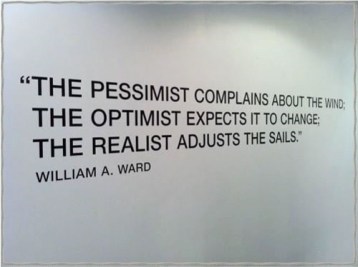
Consider the following nautical wisdom…

The PESSIMISTS complain of challenging conditions…

                              The OPTIMISTS expect the conditions to change soon…

                                                          While the SKILLED Sailor simply adjusts his sails!

Back to ‘real life,’ now,  Ask yourself:

  • Has this situation gotten to the point that the effort is no longer justified for the return I am getting?
  • Would the time, money, and effort of going backward be repaid in a reasonable time frame if I chose to stop and go backward?
  • If I keep doing what I’ve been doing, will it merely exacerbate the situation?
  • Am I putting another temporary fix in place that doesn’t address the real issue?

If you answered “yes” to any of these questions, your situation is a candidate for stopping whatever you are doing and taking a step backward. Rather than perpetuating your difficulty another day, release, cycle, or occurrence, accept responsibility for making a change.

Admit that maintaining the current direction isn’t sustainable. Rather than continue to treat symptoms, decide to address the source. Rather than maintain the troublesome status quo, identify what needs to change. Is it you? Probably. Is it also someone or something else?  Probably. Accept the need for change and rather than cover up, cope with, run from, or overlook the inevitable, decide to address it.

Once you have decided to stop and back-up, solicit the feedback and help of others… return to an informational networking approach in your job search, seeking wise counsel. Have the conversations that need to be had. Involve your key stakeholders. Do the research and analysis needed. Identify the issues to be addressed, learn any lessons to be learned, agree on the solution that solves the issues, and edit your Personal Marketing Plan to be implemented. Do what is needed to start heading in the direction that enables the future you desire.

Adjust your own sails!

Take heart. Most every great advancement was preceded by a step backwards. Most every success was preceded by a failure. Most every self-improvement was preceded by adversity. It is through mistakes and obstacles that we gain experience and grow.