YOUR DIGITAL FOOTPRINT: A LinkedIn Primer

chalk1Networking is a primary means of finding and landing  that next right employment opportunity. Social Media is an internet phenomenon that has become a very important tool for job seekers to use in their networking efforts. It is an extraordinary method for self-marketing. In fact, I like to call it your “GPS for Efficient Networking Activity.”

CAUTION:  USE TECHNOLOGY to save time and access information, but NEVER allow technology to replace person-to-person networking and relationship building. NETWORKING is a (very personal) contact sport!


THIS WEEK’s Session:  Thursday, October 11th, 8:45 AM at The Egg and I:  A LinkedIn PRIMER:  TASK#1, Evolving Your Profile


Pilot OnboardThe “top three” social media sites for job search are Facebook, LinkedIn, and Twitter

LINKEDIN

LinkedIn is the most used social media site for business and professionals. Thus, it is an excellent site for job-search purposes. Recruiters and the more sophisticated companies use LinkedIn to source potential candidates for their open positions.  Facts about LinkedIn…

  • LinkedIn is a business networking tool, not a social networking site
  • Over 500 million LinkedIn users and trending up
  • Approximately I million new users added each week
  • Close to half of all LinkedIn users are in the U.S.
  • Executives in every Fortune 500 company are users
  • It is estimated that 85% of all recruiters use LinkedIn to find talent
  • Recruiting services is one of the major sources of revenue at LinkedIn
  • LinkedIn offers both free and fee-based services, but you do not need to pay to effectively use this networking tool

LinkedIn is like a multi-faceted “diamond” for networkers.  In fact, it might be helpful to see the multiple functionalities of LinkedIn in three “tasks.”  Your TASK#1 Is to have an account and create a high impact Profile that is in sync with your resume.

Already you need to make an important decision.  Will you be using LinkedIn to PUSH your message outward, creating visibility for you availability?… or using LinkedIn to PULL people to your KEYWORDS?… or, my favorite, using both approaches together.

TASK#1: Having a LinkedIn Profile that “fits” your use of social media, including a Headline and SUMMARY that allows you the best of PUSH and PULL marketing tactics…

YOUR HEADLINE…

BUSINESS ANALYST: Operations Accounting | Database Administration | Financial Analysis | (more if space allows)

 YOUR SUMMARY…

(Start by copying and pasting from your resume… then personalize by putting the nouns back in and adding KEYWORD accomplishments…)

I am a resourceful and productive Business Management professional with over twenty years of diverse and progressively responsible experience in a fast paced dynamic environment.  My proven strengths lie within the areas of accounting and administrative assistance.  I am used to the dynamic demand of operations accounting, customer service, database management, data collection and analysis, and prioritizing workload.   I’ve been reviewed consistently for having a pro-active attitude, focusing on the customers and their needs.

Managers seem to value me as a detail-oriented, critical thinker who thrives in a team environment with diversified stakeholders and clientele, focused on personal development and process improvement. Proficient within proprietary and other systems, as well as Microsoft Excel.

OPERATIONS ACCOUNTING: I was promoted to continue previous retail billing duties with the addition of commercial billing duties for commercial and retail platform.  I coordinate with customer service and manufacturing to obtain information related to customer’s account and orders.

DATABASE ADMINISTRATION: I’ve prepared detailed invoices per customer contract for commercial accounts, including credit allowances to customer as required by account contract.  I have also assisted with individual account budgets, providing data input of pricing, cost, VAR information.

FINANCIAL ANALYSIS:  I prepare detailed invoices, including credit allowances to customer as required by account contract.  This requires knowledge of customer contracts, pricing list, invoice discounts and rebates when applicable.

Available for immediate contact at phone# and email address

***

TASK#2 is to learn the various functionalities that allow you to find new connection, grow and focus your network, and find useful information.

  1. Join LinkedIn groups and post comments
  2. Post relevant content in groups
  3. Post questions
  4. Promote events in which you are involved

 TASK#3 is to exploit the JOBS and job seeking functionalities.

WHY Focus on Achieving CareerFIT?

roadsign-banner2In order to market yourself, you must first know yourself.  The job search process is essentially a highly personalized marketing process.  The process starts with your candid self-assessment, which allows you to gain a thorough and workable understanding of who you are in product marketing terms.  When a Company looks for qualified employees, they seek functional evidence that demonstrates a job seeker’s ability to perform to expectations… JOB REQUIREMENTS represent the HR screening process!


THIS Week’s Session: Thursday, September 27th… Achieving CareerFIT,  Taking a look at the “real you” to assist you in making challenging career decisions, then creating your communication strategy to “get the word out.”


Ready+aim+fireEspecially if you are starting a resume “from scratch”, or if you are truly unsettled on next steps along your career path, this becomes a necessary first step in the process.

WHY?

There’s a reason for the ol’ cliche’, Ready-Aim-FIRE! You actually hit more targets.  In job search terms, all your preparation and knowledge of the process is close to worthless without the vital AIM which is accomplished through Achieving CareerFIT

  1. Employers are looking for applicants who FIT work requirements, so why shouldn’t you be seeking the next appropriate work opportunity?  Your value proposition (what YOU offer) needs to be in sync with the employer’s needs.
  2. If you lack specific and clear career objectives, you WILL conduct a random search!
  3. Having appropriate offer criteria allows you to research efficiently and ask the right questions during networking and the interview process.
  4. When your employment ‘fits’ the real you, you are more likely to find your employment more satisfying.

What YOU Do Best, and are motivated to do for a future employer…

What do you do best?  What are your strongest transferable skills?  Think broadly in terms of managerial and technical/ functional strengths involved in what you have to offer.  Discovering your “pattern of success and satisfaction” is your goal, here.

Your ability to express the collection of your functional strengths will measure your marketability.  This collection of keywords and their supportive evidence creates your communication strategy, the basis of your value proposition.

NOTE:  The old “round peg in a round role” theory of career planning is dysfunctional.  In the typical professional environment today, job descriptions are changing faster than ever before to keep up with the challenges of an economy in transition. In the traditional job market, job seekers are the sellers and their potential employers are the buyers.  The commodity is JOBs and the competition is fierce.

In The OTHER Job Market, buyers and sellers hold equal responsibility for the recruitment process.  The commodity is available, productive WORK… When employers have a need for someone to fulfill a specific role, often the most desired candidates are employed individuals with the credentials they seek.  Thus the employer must sell their Company to potential employees in the marketplace in order to attract the best of the lot.  Once identified, they simply select their choice and buy their services.

Seize control of such challenges.   Understand the nature of FIT.  

What is a Good, Career FIT For You?  To achieve a good “fit” between you and any future opportunity, you have to ask yourself some basic questions about yourself and your prospective employers. The fit depends on how well the jobs meets your needs and how well your skills and abilities meet the employer’s needs. The employer will make a decision and extend an offer to you: now it is time for you to make your decision.

Write out the factors that are important to you in a job… actually write out your list.  During your career transition, learn the value of setting your offer criteria, a key element of your Personal Market Plan:

  • Creates an objective target for your efforts ahead;
  • Gives you a meaningful set of questions to ask during research (factual information) and networking (more subjective information);
  • Provides an objective way to analyze and react to offers as they occur.

 OFFER CRITERIA

Write out the factors that are important to you in a job…actually write out your list. During your career transition, you learn the value of setting your offer criteria.

1. Creates an objective target for your efforts ahead;
2. Gives you a meaningful set of questions to ask during research and networking;
3. Provides an objective way to analyze and react to offers as they occur.

To manage your career wisely has you extending the same concept.

  • Keep your “offer criteria” in that dynamic state of change that allows you to adapt to market conditions.
  • If your current goal is to find a new position, then you should prepare your search as a “business model”, manage it accordingly, be flexible, and be ready for the unexpected.

You understand that managing your own career involves three key ingredients:

  1. Confidence in knowing that your career is on the right path;
  2. Continuous research and networking leading to awareness of potential “next steps…” to keep your career moving forward;
  3. Competency with job-changing skills.

To manage your career wisely has you extending the same concept.  Consider some of the factors listed below … Examine each factor through the questions listed – and then ask “does this opportunity fit me?”

Work Requirements and Expectations: What is the next  appropriate work for you? Is the work process or project oriented?  If it’s process oriented, are the requirements and expectations clear?  What kinds of projects will you work on? Will you work on one project at a time, or multiple projects? Are the projects long term or short term? Will you work on a project long enough to see the end result? Is it important to you to be able to see the project as a whole, including the result? Or will you be content to do the work without a big picture understanding?

Work Environment: Will the work space be a source of comfort and confidence for you? How formal or informal is the environment? Hectic, fast paced? Will you have the opportunity to have flex time, or to tele-commute? How many hours a week does the employer expect you to work? Will you have the freedom to wear casual clothes? What is a typical day like at the company you are considering?  Would they allow a “trial visit” or at least a site visit?

Career Path: Is there a defined succession plan? What position(s) can you move to next? How long do new hires generally stay in the same job? How quickly do people get promoted? Are your opportunities for professional development well defined and available to you? Are mentors available?

Training and Personal Development: what kind of training will you get from the employer to do the job? What kind of training will you get to stay current in your area of interest? Are the answers to these two questions different? Does it matter to you if the answers are different?

Getting ‘The Feel’ For FIT

Compass-seaLEvery step in the job search process is aimed at obtaining interviews.  It is at that point, a potential hiring manager decides if you are right for the job, and, just as important, it is your time to evaluate whether the job is right for you. Most interviews follow a predictable format, with steps that both the interviewer and applicant follow to decide if both will benefit from working together. The best interviews are ones in which both participants are equal and can have a mutually beneficial, interactive conversation regarding the opportunity at hand.


THIS Week’s session, Thursday, September 6th: Closing The Deal I, a discussion of interviewing strategies, including MoneySpeak and PRE-Offer negotiation


bob-maher-4587-editThink of an interview as the natural extension, the successful result, of your effective networking.  Many networking conversations actually become screening interviews, where influential contacts are assessing your qualifications, skill sets and experience relative to an opportunity at hand.  “Perfect practice” of the basics builds the confidence necessary to perform well in formal job interviews.

The Three Phases of Every Interview

 There are three things that must be discussed in every interview:  First, the Candidate, a discussion usually conducted in the past tense to assess experience, knowledge, and skills… do they meet the potential employer’s REQUIREMENTS?

Second, the job itself.  Beyond meeting requirements, each Candidate must be judged for their potential to meet EXPECTATIONS.  As important, will the Candidate “fit in” on the team and Company culture?  This discussion occurs in the future tense… very obvious transition in a “good” interview.

Third, is the quality of FIT.  While this is the most subjective and dysfunctional part of the process, it is where both sides must come together for a desired outcome.  When both sides like and find the other to be attractive, a “right” employment opportunity can result.  This is also where the QandA can become more defensive in nature.

Research the company/position

 Second level research will help you to identify attractive companies.  But, this is third level (in-depth) research.  Learn as much as possible about the company, the position and the individual who will be conducting the interview.  Your research goals ought to include developing information about the company’s products, people, organizational structure, successes (and failures), profits (and losses), capital spending, strategic plans, philosophy and labor climate.

Showing your knowledge of some of this information can give you added credibility over other candidates interviewing for the job.

Use the following research strategies:

  • Research the company web site, looking for information relative to your function and level… a company’s financial and annual reports can provide clues to their stability and market share. Don’t forget directories, trade journals, the “business press,” and databases of articles and other news.
  • Don’t forget your friend, LinkedIn… have you been FOLLOWing the Company?
  • Ask a friendly recruiter, business acquaintance or stockbroker what they know about the company… and by extension, call people with whom you have networked and ask what they know about the company and/or the individual(s) conducting the actual interview.
  • Check with the local Chamber of Commerce or Better Business Bureau.
  • Call the company directly; request a sales brochure, annual report or other company information. Companies have to market themselves, too, you know

Know the needs of the company

Once your basic research is complete, you must next identify how your abilities, experience and expertise can meet the needs of the interviewer, the company and the job.  This point cannot be over-emphasized.

It is the company’s needs that you must fill, not your own.  Surprisingly, however, by meeting the company’s needs, your needs also will be met.

Your VALUE PROPOSITION

Prepare for your interviews (and networking meetings) by fully understanding the value you bring to a potential employer and hiring company.    Incorporate portions of this information into your interview responses, or use some of the material in your interview closing remarks.  Tell them why you are good at what you do!

Have your knowing NOTION of FIT going in to any interview!

PLAN Before You’ll Need a Plan

Compass-seaLWhile involved in ‘the challenging waters’ of career transition, the same chaotic, jobless, trying times are very productive times. Don’t waste them by floundering with lack of focus and direction, falling into the dark, depressive attitude of distractions and, worst of all, inaction…

When we are employed, we tend to function under the guidance of our employer’s business plan, or, more specifically, our job description. Our ‘routine’ is defined by:

  • Personal accountability to a labyrinth of responsibilities, some structured— some not structured at all—but all contributing to productive work activities…
  • We create productivity and efficiency with our sense of time management…
  • And as ‘top talent’ professionals, we often take initiative, make process improvements, and contribute to the Company’s growth.

This Week’s Session, Thursday, August 2nd, 8:45 AM, at The Egg and I Restaurant in Addison… Developing Your Personal Marketing Plan


chalk1So, why not recreate all that with OUR OWN PLAN, a Personal Marketing Plan, to move toward job satisfaction, commitment, and appropriate compensation, for the rest of our careers… including any current, short term job search?   But, before looking at what such a Personal Marketing Plan would look like, let’s review the PREPARATION Portion of the 12-step Process Model (on the left).
If an individual is under-employed, seeking a change, or actually unemployed, they must be visible to potential employers who are seeking their services. Creating this visibility is strategic, personal market planning and execution—in can be marketability without rejection!

And, employed or not, Modify and improve your Personal Market Plan’s implementation model as needed… As you move through your career transition or ‘job search campaign,’ make adjustments as you would a business model.

BRANDING Yourself In The OTHER Job Market

Your “market-tested” RESUME TEMPLATE can now serve as the basis of your correspondence templates. Become familiar with the AUTO TEXT and MAIL MERGE applications within MS Word to create efficiency in the editing of your templates to meet the needs of specific opportunities that you are marketing yourself to.

Now it is REALLY beginning to feel like YOU are market-ready… but, THE Careerpilot encourages you to be totally prepared before you do. Let’s not forget to be prepared for the digital face of the job market…

 LinkedIn Task#1: INITIATING YOUR SOCIAL MEDIA STRATEGY

The Careerpilot’s high TECH-HIGH TOUCH philosophy comes into play with the explosive growth of using social networks to recruit top talent and for job seekers to build relationships, meet new contacts, and market themselves. While the Internet provides many choices, diving into the virtual meet-and-greet can represent a real challenge.

Which one is worthy of your start-up investment: learning curve time and actual ROI of your efforts… Where to begin? The Careerpilot encourages a choice that reasonably assures one’s confidentiality, has a multitude of useful applications, and can serve as your focal point of networking decisions… LinkedIn.

INITIAL RESEARCH:  To Create Focus

 Make a concerted effort to research trends and target organizations of geographies, industries, and functions that interest you. Access market research reports, the Internet, your own network… start with the resources with which you are already comfortable. Develop your research awareness and abilities.

Begin to assemble your INITIAL Target Organization List.  Start your list of companies and industries that are attractive to you. Your targets are companies that utilize the functionality and RESULTS that you can bring to the table. A great start is to consider industrial trends in the marketplace that point to an organization’s need for your services.

 INITIAL CONTACTS List

 Make a list of coworkers, bosses, customers, suppliers, associates, external consultants, etc. Make a list of family, extended family, friends, relatives of friends, neighbors, people you know from special interest groups like bowling or bridge, church contacts, former classmates or alumni, and professionals like your doctor, dentist, or hair stylist.

Surviving and Thriving in “The Sea of Unwashed Faces”

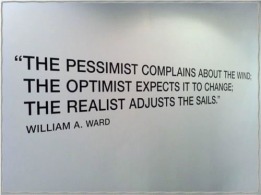
AjustDaSailsIn the traditional marketplace, potential employers seem to have the upper hand… but like the ol’ half full glass of water, remember that from the employer’s view available top talent seems like a sea of unwashed faces, too.

So what is it that the job seeker can control to make THEIR face stand out…network to and interview with the true decision maker… BE the chosen one?


THIS Week’s Session: Thursday, July 12th at The Egg and I…

Embracing The OTHER Job Market


bob-maher-4587-editStanding-out in the “sea of unwashed faces” becomes the simple matter of adjusting ones sales when in the challenging waters of career transition.

Create an expectation of who you are and what you can do for your next employer by clearly positioning and targeting your collateral materials, both written and verbal.  When stating your career objective, clearly state your appropriate work and make an offer of your services.

Here are some tips on becoming a valued partner…

Walk the talk.  Nothing speaks louder than results…. From the recruitment perspective, the best indicator of one’s potential for success is one’s prior experience and results gained.  A partner helps others within the organization achieve their goals. And results require actions, not just words. The better the results you get, the more likely you are to be invited on to ‘the team.’

Deep knowledge. You must have a true understanding of every aspect of the business, how all the moving parts work together, the obstacles ahead, and intimate knowledge of the competition in the marketplace. In other words, you’ve done your homework and understand your potential employer’s need.  And you must be able to articulate your understanding to anyone involved in the decision-making process in a manner that demonstrates that you truly get it.

Two of the many ways of accomplishing this image are to…

  1. Keep a file of relevant articles to share with key decision-makers, take advantage of the approaches that email and social media have to offer… create and maintain top-of-mind awareness.
  2. Further, create a set of ‘white papers’ that express, from your knowledge and experience, your perspective on relevant issues to your Profession or industry of choice.

Listen well. Everyone loves to feel that they have been heard and understood. One attribute of leadership is being known as a good listener. And if you can reiterate and articulate what has been said, you will be valued as a partner in the decision-making process.

Remember, as a job seeker, NETWORKING is your way to share knowledge, ‘branding’ yourself as a valued resource.  It is also your best source of confirming the subjective information you seek to supplement your research of factual information about a potential employer.

Big picture thinking. Having a strategic vision requires you to see all areas of the business, internal and external.   This is a valuable trait well beyond the C-suite.  If you only have a deep understanding of one area, you are more likely to be tactical in your decisions, rather than strategic.

You must be able to foresee problems from the stakeholders’ perspective in order to offer the most highly valued and comprehensive solutions.

Tying all of this together, the best way to be treated like a valued partner is to act like one. The more you demonstrate your value, the more you will become recognized as the new go-to person in the organization.

Banging On The Screen Door

chalk1The term “third party recruiter” goes by many names, including contingency agencies, executive search firms, retained search firms, employment agencies, headhunters, recruiters, and temp agencies.  These all fall under the umbrella of the “staffing industry.”

Contingency Agencies are paid by the company after the agency’s candidate is hired…their sourcing process is a paperwork mill.

Retained Search Firms custom locates candidates for a company and are paid upfront or on a progress basis (retained basis). Their sourcing process is often more focused and conducted on a more personal level.

Employment Agencies are contracted by companies to find candidates for temporary or permanent positions.  Often their sourcing and screening activity is conducted in parallel to Corporate recruiting efforts.

Temporary (Temp) Agencies find candidates to fill temporary jobs and “temp to perm” positions.  This includes the Lease2Perm TECHNICAL firms.


This week’s session, Thursday, June 28th at The Egg and I: An exploration of the third-party world of recruitment


bob-maher-4587-editIn embracing The OTHER Job Market, a successful professional seeking their next appropriate employment will learn the technique of using the services of a third party recruiter.  Our goal is to understand their world, from THEIR viewpoint, in order to optimize the effectiveness of our efforts looking for work.

HOMEWORK for this week’s session…

The American Staffing Association (ASA)

TEXAS specific statistics… Third-party recruitment statistics in Texas

As promised here is more of my list of things you should take into consideration when working with staffing agencies.

  1. Working with a staffing agency does not guarantee placement in a job.  It’s one of many techniques to use in your job search.
  2. Staffing agencies do the initial screening, saving the employer time and money… they are an extension of the employer’s recruiting and screening process.
  3. Don’t abdicate the tasks of the job search to a recruiter who is busy working with lots of job seekers.
  4. Reducing or stopping your networking efforts once you start using a staffing agency is a huge mistake.
  5. Approximately 79 percent of staffing employees work full-time according to the American Staffing Association (ASA).
  6. Recruiters have contacts in the business community which only extends your networking outreach.
  7. Employers that experience an unexpected increase in business may favor hiring temps before hiring permanent workers.
  8. Companies are using staffing agencies to “test drive” the performance of a temp before offering a permanent position.
  9. The ASA notes that 12 million Americans will work at some point during the course of the year in as a temp or contract employee.
  10. Temping is not a step down.  It’s money, connections, a resume gap stopper and an opportunity to get your foot in the door.
  11. Signing up with a staffing agency is usually quick and easy, much of which can be done online.
  12. While actual titles may vary, there are basically three functions within any one staffing firm: those that identify and bring in the actual job orders, those that identify and initially screen potential applicants, and those that administer the firm’s process.
  13. Network with your LinkedIn connections to learn more about the right staffing firms to use; use more than one agency. “Reach out” to at least two firms each week within your Personal Marketing Plan.
  14. Check the phone book or Internet for a list of staffing agencies; also use the Internet to find additional information…CAUTION: There is no directory of the ‘good ones.’ THAT is a matter of your personal relationship with them.
  15. Schedule an appointment with a staffing agency representative.  Dress to impress, show your smile and give a firm handshake.
  16. Make sure your resume has been professionally critiqued before you submit it to a staffing agency.

* more to follow *


The OTHER Job Market Has a Screen Door, Too!

Compass-seaLJust as in traditional job search, there are four avenues in to more efficient and productive job search: Classified advertising, third-party recruitment services, employer job postings (this trio can be addressed by using the Internet ‘job boards’), and personal contact networking.

One of the many keys to unlocking the screen door of The OTHER Job Market is to sieze control of the process and take actions like that of an equal partner in the recruitment process.


This week’s session, Thursday, June 28th at The Egg and I: An exploration of the third-party world of recruitment


bob-maher-4587-editIn embracing The OTHER Job Market, a successful professional seeking their next appropriate employment will learn the technique of using the services of a third party recruiter.  The term “third party recruiter” goes by many names including contingency agencies, executive search firms, retained search firms, employment agencies, headhunters, recruiters, and temp agencies.  These all fall under the umbrella of the “staffing industry.”

Contingency Agencies are paid by the company after the agency’s candidate is hired…their sourcing process is a paperwork mill.

Retained Search Firms custom locates candidates for a company and are paid upfront or on a progress basis (retained basis). Their sourcing process is often more focused and conducted on a more personal level.

Employment Agencies are contracted by companies to find candidates for temporary or permanent positions.  Often their sourcing and screening activity is conducted in parallel to Corporate recruiting efforts.

Temporary (Temp) Agencies find candidates to fill temporary jobs and “temp to perm” positions.  This includes the Lease2Perm TECHNICAL firms.

The number of temporary employees is growing and this trend is expected to continue.

TMI (Too Much Information)… The American Staffing Association (ASA)

TEXAS specific statistics… Third-party recruitment statistics in Texas

Temping can help you learn new skills and experience, build your network, open up options you had not previously considered and bridge employment gaps.  The goal is to get inside a company.  Here is my list of things you should take into consideration when working with staffing agencies.

  1. Some agencies have skills training to prepare employees for their assignments; others expect you to hit the ground running.
  2. Temp jobs can often be the answer when your cash reserves are running low.
  3. Temping can give you experience in careers you might not have otherwise thought of trying – without a long-term commitment.
  4. Having the flexibility from temping can work well for your job search and personal priorities.
  5. Signing up with a staffing agency is usually quick and easy, much of which can be done online.
  6. Approximately 79 percent of staffing employees work full-time according to the American Staffing Association (ASA).
  7. The ASA notes that 12 million Americans will work at some point during the course of the year in as a temp or contract employee.
  8. Temping is not a step down.  It’s money, connections, a resume gap stopper and an opportunity to get your foot in the door.

*MORE to follow*

Special Presenter This Week, Thursday, May 24th: Jeff Morris, Founder and Webmaster of CareerDFW

Giving you the tools you need to land your next great opportunity.

Such is the goal of CareerDFW.  Jeff has played a tremendous role in the leadership of community based job search support groups in the Dallas area…and he has his own Group that meets in North Plano every Friday morning.


THIS WEEK’s Session, Thursday, May 24th:  Exploring the CareerDFW website with its Founder and Webmaster, Jeff Morris


roadsign-banner2If you are a job seeker in the DFW Metroplex, you are blessed to be living in the best place in America to be unemployed: good industry mix, excellent community-based (free) resources, and an economy that just keeps on growing.  The best way to take advantage is to ’embrace the OTHER Job Market…’ by understanding the key words in the CareerDFW’s GOAL…

chalk1Professional individuals should consistently be aware of and in the market for their next great opportunity. This is an efficient and productive career strategy that will serve anyone well for the rest of their working life.

DFWCareerpilot, quite similar in name, shares in and totally supports this common goal, helping professional people navigate the challenging waters of career transition.

Getting “The (Key)Word(s)” Out

roadsign-banner2In order to market yourself, you must first know yourself.  The job search process is essentially a highly personalized marketing process.  The process starts with your candid self-assessment, which allows you to gain a thorough and workable understanding of who you are in product marketing terms.

When a Company looks for qualified employees, they seek functional evidence that demonstrates a job seeker’s ability to perform to expectations… JOB REQUIREMENTS represent the HR screening process!

Especially if you are starting a resume “from scratch”, or if you are truly unsettled on next steps along your career path, this becomes a necessary first step in the process.


NEXT Session:  Thursday, April 26th… Achieving CareerFIT II : Creating your communication strategies to drive your Personal Marketing collateral materials.


chalk1The important second step in the process is to specifically and clearly position your career objectives.  What do you do best?  What are your strongest transferable skills?  Think broadly in terms of managerial and technical/ functional strengths involved in what you have to offer.  Discovering your “pattern of success and satisfaction” is your goal, here.  Your ability to express the collection of your functional strengths will measure your marketability.

This collection of keywords and their supportive evidence creates your communication strategy, the basis of your value proposition.

The old “round peg in a round role” theory of career planning is dysfunctional.  In the typical professional environment today, job descriptions are changing faster than ever before to keep up with the challenges of an economy in transition. In the traditional job market, job seekers are the sellers and their potential employers are the buyers.  The commodity is JOBs and the competition is fierce.

In The OTHER Job Market, buyers and sellers hold equal responsibility for the recruitment process.  The commodity is available, productive WORK… When employers have a need for someone to fulfill a specific role, often the most desired candidates are employed individuals with the credentials they seek.  Thus the employer must sell their Company to potential employees in the marketplace in order to attract the best of the lot.  Once identified, they simply select their choice and buy their services.

Seize control of such challenges.   Understand the nature of FIT… from YOUR perspective, making the process easier to control. 

OFFER CRITERIA

Write out the factors that are important to you in a job…actually write out your list. During your career transition, you learn the value of setting your offer criteria.

1. Creates an objective target for your efforts ahead;
2. Gives you a meaningful set of questions to ask during research and networking;
3. Provides an objective way to analyze and react to offers as they occur.

To manage your career wisely has you extending the same concept.

  • Keep your “offer criteria” in that dynamic state of change that allows you to adapt to market conditions.
  • If your current goal is to find a new position, then you should prepare your search as a “business model”, manage it accordingly, be flexible, and be ready for the unexpected.

You understand that managing your own career involves three key ingredients:

  1. Confidence in knowing that your career is on the right path;
  2. Continuous research and networking leading to awareness of potential “next steps…” to keep your career moving forward;
  3. Competency with job-changing skills.

To manage your career wisely has you extending the same concept.  Consider some of the factors listed below … Examine each factor through the questions listed – and then ask “does this opportunity fit me?”

Work Requirements and Expectations: What is the next  appropriate work for you? Is the work process or project oriented?  If it’s process oriented, are the requirements and expectations clear?  What kinds of projects will you work on? Will you work on one project at a time, or multiple projects? Are the projects long term or short term? Will you work on a project long enough to see the end result? Is it important to you to be able to see the project as a whole, including the result? Or will you be content to do the work without a big picture understanding?

Work Environment: Will the work space be a source of comfort and confidence for you? How formal or informal is the environment? Hectic, fast paced? Will you have the opportunity to have flex time, or to tele-commute? How many hours a week does the employer expect you to work? Will you have the freedom to wear casual clothes? What is a typical day like at the company you are considering?  Would they allow a “trial visit” or at least a site visit?

Career Path: Is there a defined succession plan? What position(s) can you move to next? How long do new hires generally stay in the same job? How quickly do people get promoted? Are your opportunities for professional development well defined and available to you? Are mentors available?

Training and Personal Development: what kind of training will you get from the employer to do the job? What kind of training will you get to stay current in your area of interest? Are the answers to these two questions different? Does it matter to you if the answers are different?

Achieving CareerFIT: Assessing Yourself

Understand that managing your own career involves three key ingredients:

1. Confidence in knowing that your career is on the right path;
2. Continuous research and networking leading to awareness of potential “next steps…” to keep your career moving forward;
3. Competency with job-changing skills.


This week’s session- Thursday, April 19th… Achieving CareerFIT I, a closer look at the decision-making aspects of self assessment, the YOU part of the equation!


Compass-seaLTo manage your career wisely has you extending the same concept. Consider some of the most personal factors listed below … Examine each factor – and then ask “does this opportunity fit me?”

Your confidence in determining appropriate “next steps” along your career path, and then acting on them, is critical in determining the success of your career transition efforts.  This decision can be daunting if you don’t take the time to determine what you “bring to the tale…”

Strengths          Strengths differ from skills, in that your strengths were not learned or taught, but inborn.  The kind of things which you find easy to do, when others struggle with the same task, can be thought of as a strength.  Unfortunately, many people never recognize their strengths, or don’t see a way to use them in the work roles they have played. But, what if you could….?


Skills                     What we have learned, developed, or have experienced in the workplace.  Those tasks you have performed for another employer, for pay, in the past.  You need to consider skills in two ways: 

  1. Competency, or how good you are at the skill, as well as…
  2. Motivation, how you feel about performing the skill.  You want to focus on skills where you have both High Competency and High Motivation for your future career development. 

Be careful about those skills with High Competency, but Low Motivation.  If you would rather never perform a skill that you have done well for years, it might not be wise to include that skill in your personal marketing collateral materials.

Interests      What kind of things would you enjoy doing, or learning about, even if there was no paycheck involved? Can you identify some topics or activities to which you are, and have always been, naturally drawn?  Passions are simply very strong interests, and you may have heard someone give career advice about “following your passion!) Interests combined with skills can be very rewarding in the workplace.


Personality/Emotional Intelligence We are all different from one another, in many different ways.  Those differences do not make us wrong, or bad, but they can create conflict or poor communication between people who do not appreciate or understand natural differences.


Learning how you “see the world” differently than other people do can provide clues to how to better understand or relate to people.  This can provide a major advantage in a person who has to work with others, or lead others.  What are your natural preferences? The answer to this question can guide a person to make better decisions regarding their career.


Another difference that has gotten a lot of attention in recent years surrounds the issue of Emotional Intelligence.  This is the degree by which a person is both aware of their and other’s emotional state, as well as the degree by which they manage those emotions.  It seems likely that the higher your EQ, the more likely you will find success in relationships and in the workplace.


 Values     What is most important to you, and what will you protect or defend if necessary? How do you expect to be treated in the workplace, by co-workers and leaders? What are the “rules” by which you choose to live your life? These are the rules that define how you, and others, should behave in society.  These “rules”, or values, can be the most important self-awareness a person should draw from when considering career moves.


If the work you do, or the people and organization where you perform you work, share some of your highest values, you are more likely to feel satisfied and fulfilled in that work.  Where our higher values are routinely violated, or when we are required to abandon some of them on a regular basis at work, the result can be frustration, anger, dis-engagement, and ultimately burn-out. 


The problem is that we rarely think about our values, and probably can’t list them if asked. Even though we constantly use them to react to people or events.  Most values are buried deep in our minds.

***

Ultimately, your goal is to secure the right employment for yourself… that must start with your identification of what right is.  THAT requires some exploration, identification of key elements of your Career FIT, and planning to pull it all together, create focus… make it happen.  Yes…. FIT Happens! 


Creating an action plan, your Personal Market Plan, during career transition, will reap rewards during your implementation campaign.