ACHIEVING CareerFIT

chalk1In order to market yourself, you must first know yourself.  The job search process is essentially a highly personalized marketing process.  The process starts with your candid self-assessment, which allows you to gain a thorough and workable understanding of who you are in product marketing terms.

When a Company looks for qualified employees, they seek functional evidence that demonstrates a job seeker’s ability to perform to their best expectations… JOB REQUIREMENTS represent the HR screening process!


THIS Week’s Session:  Achieving CareerFIT, an exploration of the product analysis phase of Personal Market Planning


bob-maher-4587-editEspecially if you are starting a resume “from scratch”, or if you are truly unsettled on next steps along your career path, this becomes a necessary first step in the process.

What YOU Do Best, and are motivated to do for a future employer…

What do you do best?  What are your strongest transferable skills?  Think broadly in terms of managerial and technical/ functional strengths involved in what you have to offer.  Discovering your “pattern of success and satisfaction” is your goal, here.

Your ability to express the collection of your functional strengths will measure your marketability.  This collection of keywords and their supportive evidence creates your communication strategy, the basis of your value proposition.

The old “round peg in a round role” theory of career planning is dysfunctional.  In the typical professional environment today, job descriptions are changing faster than ever before to keep up with the challenges of an economy in transition. In the traditional job market, job seekers are the sellers and their potential employers are the buyers.  The commodity is JOBs and the competition is fierce.

In The OTHER Job Market, buyers and sellers hold equal responsibility for the recruitment process.  The commodity is available, productive WORK… When employers have a need for someone to fulfill a specific role, often the most desired candidates are employed individuals with the credentials they seek.  Thus the employer must sell their Company to potential employees in the marketplace in order to attract the best of the lot.  Once identified, they simply select their choice and buy their services.

Seize control of such challenges.   Understand the nature of FIT.  

Surviving and Thriving in “The Sea of Unwashed Faces”

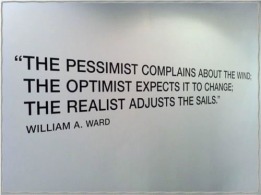
AjustDaSailsIn the traditional marketplace, potential employers seem to have the upper hand… but like the ol’ half full glass of water, remember that from the employer’s view available top talent seems like a sea of unwashed faces, too.

So what is it that the job seeker can control to make THEIR face stand out…network to and interview with the true decision maker… BE the chosen one?


THIS Week’s Session: Thursday, July 12th at The Egg and I…

Embracing The OTHER Job Market


bob-maher-4587-editStanding-out in the “sea of unwashed faces” becomes the simple matter of adjusting ones sales when in the challenging waters of career transition.

Create an expectation of who you are and what you can do for your next employer by clearly positioning and targeting your collateral materials, both written and verbal.  When stating your career objective, clearly state your appropriate work and make an offer of your services.

Here are some tips on becoming a valued partner…

Walk the talk.  Nothing speaks louder than results…. From the recruitment perspective, the best indicator of one’s potential for success is one’s prior experience and results gained.  A partner helps others within the organization achieve their goals. And results require actions, not just words. The better the results you get, the more likely you are to be invited on to ‘the team.’

Deep knowledge. You must have a true understanding of every aspect of the business, how all the moving parts work together, the obstacles ahead, and intimate knowledge of the competition in the marketplace. In other words, you’ve done your homework and understand your potential employer’s need.  And you must be able to articulate your understanding to anyone involved in the decision-making process in a manner that demonstrates that you truly get it.

Two of the many ways of accomplishing this image are to…

  1. Keep a file of relevant articles to share with key decision-makers, take advantage of the approaches that email and social media have to offer… create and maintain top-of-mind awareness.
  2. Further, create a set of ‘white papers’ that express, from your knowledge and experience, your perspective on relevant issues to your Profession or industry of choice.

Listen well. Everyone loves to feel that they have been heard and understood. One attribute of leadership is being known as a good listener. And if you can reiterate and articulate what has been said, you will be valued as a partner in the decision-making process.

Remember, as a job seeker, NETWORKING is your way to share knowledge, ‘branding’ yourself as a valued resource.  It is also your best source of confirming the subjective information you seek to supplement your research of factual information about a potential employer.

Big picture thinking. Having a strategic vision requires you to see all areas of the business, internal and external.   This is a valuable trait well beyond the C-suite.  If you only have a deep understanding of one area, you are more likely to be tactical in your decisions, rather than strategic.

You must be able to foresee problems from the stakeholders’ perspective in order to offer the most highly valued and comprehensive solutions.

Tying all of this together, the best way to be treated like a valued partner is to act like one. The more you demonstrate your value, the more you will become recognized as the new go-to person in the organization.

What IS This OTHER Job Market?

Compass-seaLIn every marketplace, there are buyers and sellers.  In the traditional job market, the one that our Department of Labor measures for us, job seekers are the sellers and their potential employers are the buyers.  The commodity is productive work and the competition is fierce.

It doesn’t matter if you are an operations manager, an internal HR professional, senior finance executive, or a key player on the IT team—ANY experienced and valued professional job seeker—ALL want to become a valued partner in the business of their next employer.


NEXT Session, Thursday, July 12th at The Egg & I: Embracing The OTHER Job Market, our introductory and overview look at The 12-Step process


chalk1Everyone wants a voice in strategic decisions and to be included in ‘the conversation.’ To truly be included, you need to be invited. And you will only be invited if you are seen as absolutely essential to the TEAM.  Remember, team player and team leader CAN BE interchangeable terms.

In the OTHER Job Market, buyers and sellers hold equal responsibility for the recruitment process.  When employers have a need for someone to fulfill a specific role, often the most desired candidates are employed individuals with the credentials they seek.  Thus the employer must sell their Company to potential employees in the marketplace in order to attract the best of the lot.  Once identified, they simply select their choice and buy their services. 

The JOB Market The OTHER Job Market
Characterized by “requisitioned” jobs being filled by chosen job seekers. Characterized by available/needed work being fulfilled by job seekers, contractors, internal candidates, third-party consultants, retirees, part-timers, temporary workers, etc.
JOBS rigidly defined by requirements and qualifications… reflected by the screening process aimed at identifying key candidates. Work expectations are subjective, defined by mutual agreement, fulfillment of need or contract… reflected through the identification of qualified candidates.
Process overseen by Human Resource professionals, regulated to consider minimally qualified candidates, hopefully within salary guidelines. Process directed by hiring authorities seeking best available talent at marketplace salary expectations.
JOB Seeking PUBLIC is screened for most desirable candidates. Qualified and available candidates are sourced and recruited, often through process of endorsement or internal referral.
Screening defined by KEYWORDS, often accomplished through computer/internet job banks and resume databases. Screening accomplished by word of mouth and endorsement, often supplementing the organization’s formal process of recruitment.
Recruitment process subject to scrutiny of regulation and political correctness. Often selection process has occurred before active recruitment has been fully engaged.
Actual selection still subject to formal process and subjective choice. Actual selection often a rubber stamp formality to satisfy regulation requirements.

On the other hand, if an individual is under-employed, seeking a change, or actually unemployed, they must be visible to potential employers who are seeking their services.  Creating this visibility is strategic, personal market planning and execution—in can be marketability without rejection!

Personal Marketing is a contact sport.

YOUR Digital Footprint

REMEMBER Memorial DayThe Careerpilot’s high TECH-HIGH TOUCH philosophy comes into play with the explosive growth of business professionals using social networks to build relationships, meet new contacts, and market themselves.  While the Internet provides many choices, diving into the virtual meet-and-greet can represent a real challenge.  Which one is worthy of your start-up investment: learning curve time and actual ROI of your efforts…  Where to begin?


Bob is back and will be facilitating This Week‘s Session, Thursday, May 31st…                     A LinkedIn Primer: Task #2 and #3, a discussion of how to extend the reach of your contact network…extending your digital footprint


Pilot OnboardThe Careerpilot encourages a choice that reasonably assures one’s confidentiality, has a multitude of useful applications, and can serve as your focal point of networking decisions.

A terrific launching site for such an effort is LinkedIn. Developed specifically for business, the site doesn’t run the risk of blurring your professional life with your private one; and, it serves virtually every industry and profession.

Joining a network like LinkedIn is simple, but turning it into a powerful networking tool takes a bit of savvy. Here’s how to build a network, leveraging your available time… and put it all to work — without HIGH TECH, social-networking anxiety.

TASK #2  Build Your Network

Goal: Stay focused.  Only connect with others who share your professional interests or are related to those interests in a complementary way… and can help you meet your goals.  After you’ve created your profile, it’s time to begin to connect to others.

LinkedIn will allow you to search for people you know to see if they’re already members. But once you connect to someone, you can also look at the profiles of anyone they know, and in turn anyone those people know. Because of these three degrees of separation, your network can grow rapidly.

Before you begin connecting, decide who you want to connect to. LinkedIn suggests in its FAQ, “Only invite those you know and trust.” 

The 411 on “How Not to Be Connected”

If someone contacts you and you don’t want to form a connection with them, you don’t need to flatly reject them and worry about the attendant awkwardness. When looking at the invitation to connect, simply hit “Archive.” The other person does not receive a message saying their invitation has been rejected, and you don’t have to worry about unwanted invitations clogging up your inbox.

Likewise, if you find that an existing contact is blasting you with too much information or making overly aggressive requests for introductions and recommendations, LinkedIn will let you remove that person easily — and without the contact knowing they’re out of your network.

If only it were that easy in real life.

What’s Next?

  1. Check in on “Network Updates.” Found on your LinkedIn homepage, Network Updates are kind of like your Facebook news feed. Check these periodically for a quick snapshot of what your connections are up to and sharing. And, it’s a 2-way street: Your updates, including white papers you may choose to “publish,” go out to your network.
  2. Be identifiable. Find out who’s checking out your profile by allowing others to see who you are if you view theirs. When you click the information under “Who’s Viewed My Profile” on your profile page, you’ll be able to view users who have looked at your profile, stats on your profile’s number of views, and its appearances in search recently. To change this, go into your settings and click “See what others see when you’ve viewed their profile.”
  3. Export connections. Transfer your LinkedIn connections to another contact management system? LinkedIn enables you to easily export your connections. Just click on “Contacts,” “My Connections,” and then scroll down and click “Export Connections.” You have the option of either exporting as a .CSV or .VCF file.
  4. Leverage the power of LinkedIn Groups. Did you know that if you’re a member of the same group as another user, you can bypass the need to be a first degree connection in order to message them? In addition, group members are also able to view the profiles of other members of the same group without being connected. Join more groups to enable more messaging and profile viewership capabilities.
  5. Link your Twitter acct to LinkedIn. Share your LinkedIn status updates on Twitter, and vice versa. Learn how to connect your Twitter account in your “settings” area.

Special Presenter This Week, Thursday, May 24th: Jeff Morris, Founder and Webmaster of CareerDFW

Giving you the tools you need to land your next great opportunity.

Such is the goal of CareerDFW.  Jeff has played a tremendous role in the leadership of community based job search support groups in the Dallas area…and he has his own Group that meets in North Plano every Friday morning.


THIS WEEK’s Session, Thursday, May 24th:  Exploring the CareerDFW website with its Founder and Webmaster, Jeff Morris


roadsign-banner2If you are a job seeker in the DFW Metroplex, you are blessed to be living in the best place in America to be unemployed: good industry mix, excellent community-based (free) resources, and an economy that just keeps on growing.  The best way to take advantage is to ’embrace the OTHER Job Market…’ by understanding the key words in the CareerDFW’s GOAL…

chalk1Professional individuals should consistently be aware of and in the market for their next great opportunity. This is an efficient and productive career strategy that will serve anyone well for the rest of their working life.

DFWCareerpilot, quite similar in name, shares in and totally supports this common goal, helping professional people navigate the challenging waters of career transition.

PRODUCTIVE Job Search Strategy

AjustDaSailsWhile involved in ‘the challenging waters’ of career transition, the same chaotic, jobless, trying times are very productive times. Don’t waste them by floundering with lack of focus and direction, falling into the dark, depressive attitude of distractions and, worst of all, inaction…

When we are employed, we tend to function under the guidance of our employer’s business plan, or, more specifically, our job description. Our ‘routine’ is defined by:

• Personal accountability to a labyrinth of responsibilities, some structured— some not structured at all—but all contributing to productive work activities…

• We create productivity and efficiency with our sense of time management…

• And as ‘top talent’ professionals, we often take initiative, make process improvements, and contribute to the Company’s growth.


THIS Week’s Session, Thursday, May 10th… Preparing to execute YOUR Personal Marketing Plan

PLEASE NOTE:  Scheduling changes listed in “Plan Ahead” Tab.


chalk1So, why not recreate all that with OUR OWN PLAN, a Personal Marketing Plan, to move toward job satisfaction, commitment, and appropriate compensation, for the rest of our careers… including any current, short term job search?

If an individual is under-employed, seeking a change, or actually unemployed, they must be visible to potential employers who are seeking their services. Creating this visibility is strategic, personal market planning and execution—in can be marketability without rejection!

And, employed or not, Modify and improve your Personal Market Plan’s implementation model as needed… As you move through your career transition or ‘job search campaign,’ make adjustments as you would a business model.

Personal Marketing is a contact sport.

Following the first three steps, it may feel like you’re ready to take on the job market… but, THE Careerpilot encourages you to be totally prepared before you do.

“Coaching” Your Chosen REFERENCES…

It is essential that you make certain that persons you use as a reference will respond in a positive manner. A good rule of thumb is to select four to six references, including supervisors, indirect supervisors, customers, peers, and possibly someone of stature in your profession.

Contact every person you are using for a reference, get their permission, discuss what type of position you are targeting, and send them a copy of your ‘market-ready’ resume draft. There are times when you can actually negotiate what you want them to say.

Your reference sheet is an addendum to your resume and is taken to the interview, not sent with the resume. One way of looking at contacting your references at this point is that it marks the beginning of your focused networking, the first stage of your more active career transition efforts.

Practice your networking skills while you validate your resume DRAFT, tweaking as appropriate based on feedback from those that know and respect you.

Yes, A GREAT Resume!

Compass-seaL

Your work in Achieving CareerFIT led you to the determination of your career objective, exactly what is the best next step for you in your career transition?  It also suggested strongly that you set your straw-man offer criteria to guide you in moving forwardKnowing what your next right employment  is.

This will help focus your actual search. With clarity in your positioning and targeting goals, you can write a great resume to convey “your story.”


Next Session, Thursday, May 3rd: In Sync Personal Marketing Collateral Materials


Your Personal Market Collateral

WRITTEN COLLATERAL…

  1.  A GREAT Resume that positions you clearly as a terrific FIT with your career objectives… and in today’s technologies, a database-friendly, asci version;
  2. A correspondence template package that consistently carries your communication strategy, your message… and in today’s technologies, a reformatted, text only version of your resume ready for email needs;
  3. A high impact, personal biography and/or NETWORKING PROFILE that you can lead with in your referral based networking strategies.

VERBAL COLLATERAL…

  1.  A well rehearsed “two minute commercial,” your answer to the most asked question during career transition, “Tell me about yourself.”
  2. Several, well though out, “elevator speeches,” examples that support your primary, positioning, key words. These are usually your representative accomplishments under the SUMMARY of your resume. (30 seconds to 1 minute)
  3. A succinct “qualification statement” that you can use as an introduction at networking events. (usually 20 – 30 seconds)
  4. An “exit statement” which explains your availability, to address the second most asked question during career transition.

Having your collaterals prepared and rehearsed prior to active personal marketing is central to your success and builds confidence.

Consistency in the delivery of your message is what creates memory… and frequency of your message helps you get there… strive for top-of-mind awareness where it relates to your candidacy.

Your personal marketing COMMUNICATION STRATEGY, your story, must be built around keywords and phrases that best describe your unique value proposition. These words come from your concerted self-assessment process. The challenge is matching the words that best describe your next right employment with the words that best describe a potential new employer’s needs.

A communication strategy that does not achieve that is doomed to otherwise controllable difficulties—and, worst…failure. So, understand that getting recruited involves two distinct elements…

  • Being screened for meeting a JOB’s requirements… a subjective process created by the potential employers of the marketplace. They set the bar HIGH, defined by functional experience, skill set, and knowledge standards so they don’t have to interview every JOB applicant.
  • Being selected by the hiring authority… another subjective process which now involves their assessment of a job-seeker’s FIT with their needs, including personality, work habits, and other ‘cultural’ standards. They cannot hire all qualified candidates. They must choose.

A job-seeker, then, can give themselves choices when they choose to embrace the OTHER Job Market. They improve their probability of success by nearly eliminating the pre-mature screening and rejection process.

Instead, the SMART job-seeker chooses to build relationships with potential employers first, researching attractive trends and targeted organizations in order to maximize probability of success, avoiding the HR-driven screening process to identify appropriate opportunities for securing their next right employment.

Getting “The (Key)Word(s)” Out

roadsign-banner2In order to market yourself, you must first know yourself.  The job search process is essentially a highly personalized marketing process.  The process starts with your candid self-assessment, which allows you to gain a thorough and workable understanding of who you are in product marketing terms.

When a Company looks for qualified employees, they seek functional evidence that demonstrates a job seeker’s ability to perform to expectations… JOB REQUIREMENTS represent the HR screening process!

Especially if you are starting a resume “from scratch”, or if you are truly unsettled on next steps along your career path, this becomes a necessary first step in the process.


NEXT Session:  Thursday, April 26th… Achieving CareerFIT II : Creating your communication strategies to drive your Personal Marketing collateral materials.


chalk1The important second step in the process is to specifically and clearly position your career objectives.  What do you do best?  What are your strongest transferable skills?  Think broadly in terms of managerial and technical/ functional strengths involved in what you have to offer.  Discovering your “pattern of success and satisfaction” is your goal, here.  Your ability to express the collection of your functional strengths will measure your marketability.

This collection of keywords and their supportive evidence creates your communication strategy, the basis of your value proposition.

The old “round peg in a round role” theory of career planning is dysfunctional.  In the typical professional environment today, job descriptions are changing faster than ever before to keep up with the challenges of an economy in transition. In the traditional job market, job seekers are the sellers and their potential employers are the buyers.  The commodity is JOBs and the competition is fierce.

In The OTHER Job Market, buyers and sellers hold equal responsibility for the recruitment process.  The commodity is available, productive WORK… When employers have a need for someone to fulfill a specific role, often the most desired candidates are employed individuals with the credentials they seek.  Thus the employer must sell their Company to potential employees in the marketplace in order to attract the best of the lot.  Once identified, they simply select their choice and buy their services.

Seize control of such challenges.   Understand the nature of FIT… from YOUR perspective, making the process easier to control. 

OFFER CRITERIA

Write out the factors that are important to you in a job…actually write out your list. During your career transition, you learn the value of setting your offer criteria.

1. Creates an objective target for your efforts ahead;
2. Gives you a meaningful set of questions to ask during research and networking;
3. Provides an objective way to analyze and react to offers as they occur.

To manage your career wisely has you extending the same concept.

  • Keep your “offer criteria” in that dynamic state of change that allows you to adapt to market conditions.
  • If your current goal is to find a new position, then you should prepare your search as a “business model”, manage it accordingly, be flexible, and be ready for the unexpected.

You understand that managing your own career involves three key ingredients:

  1. Confidence in knowing that your career is on the right path;
  2. Continuous research and networking leading to awareness of potential “next steps…” to keep your career moving forward;
  3. Competency with job-changing skills.

To manage your career wisely has you extending the same concept.  Consider some of the factors listed below … Examine each factor through the questions listed – and then ask “does this opportunity fit me?”

Work Requirements and Expectations: What is the next  appropriate work for you? Is the work process or project oriented?  If it’s process oriented, are the requirements and expectations clear?  What kinds of projects will you work on? Will you work on one project at a time, or multiple projects? Are the projects long term or short term? Will you work on a project long enough to see the end result? Is it important to you to be able to see the project as a whole, including the result? Or will you be content to do the work without a big picture understanding?

Work Environment: Will the work space be a source of comfort and confidence for you? How formal or informal is the environment? Hectic, fast paced? Will you have the opportunity to have flex time, or to tele-commute? How many hours a week does the employer expect you to work? Will you have the freedom to wear casual clothes? What is a typical day like at the company you are considering?  Would they allow a “trial visit” or at least a site visit?

Career Path: Is there a defined succession plan? What position(s) can you move to next? How long do new hires generally stay in the same job? How quickly do people get promoted? Are your opportunities for professional development well defined and available to you? Are mentors available?

Training and Personal Development: what kind of training will you get from the employer to do the job? What kind of training will you get to stay current in your area of interest? Are the answers to these two questions different? Does it matter to you if the answers are different?

Exactly What IS The OTHER Job Market?

roadsign-banner2In every marketplace, there are buyers and sellers. In the traditional job market, the one that our Department of Labor measures for us, job seekers are the sellers and their potential employers are the buyers. The commodity is productive work and the competition is fierce.

It doesn’t matter if you are an operations manager, an internal HR professional, senior finance executive, or a key player on the IT team—ANY experienced and valued professional job seeker—ALL want to become a valued partner in the business of their next employer.

Everyone wants a voice in strategic decisions and to be included in ‘the conversation.’ To truly be included, you need to be invited. And you will only be invited if you are seen as absolutely essential to the TEAM. Remember, team player and team leader CAN BE interchangeable terms.


Our next session, Thursday, April 12th: Embracing The OTHER Job Market… an exploration of our basic philosophies and The 12-Step Process M.A.P.


chalk1In the OTHER Job Market, buyers and sellers hold equal responsibility for the recruitment process. When employers have a need for someone to fulfill a specific role, often the most desired candidates are employed individuals with the credentials they seek. Thus the employer must sell their Company to potential employees in the marketplace in order to attract the best of the lot. Once identified, they simply select their choice and buy their services.

The JOB Market The OTHER Job Market
Characterized by “requisitioned” jobs being filled by chosen job seekers. Characterized by available/needed work being fulfilled by job seekers, contractors, internal candidates, third-party consultants, retirees, part-timers, temporary workers, etc.
JOBS rigidly defined by requirements and qualifications… reflected by the screening process aimed at identifying key candidates. Work expectations are subjective, defined by mutual agreement, fulfillment of need or contract… reflected through the identification of qualified candidates.
Process overseen by Human Resource professionals, regulated to consider minimally qualified candidates, hopefully within salary guidelines. Process directed by hiring authorities seeking best available talent at marketplace salary expectations.
JOB Seeking PUBLIC is screened for most desirable candidates. Qualified and available candidates are sourced and recruited, often through process of endorsement or internal referral.
Screening defined by KEYWORDS, often accomplished through computer/internet job banks and resume databases. Screening accomplished by word of mouth and endorsement, often supplementing the organization’s formal process of recruitment.
Recruitment process subject to scrutiny of regulation and political correctness. Often selection process has occurred before active recruitment has been fully engaged.
Actual selection still subject to formal process and subjective choice. Actual selection often a rubber stamp formality to satisfy regulation requirements.

On the other hand, if an individual is under-employed, seeking a change, or actually unemployed, they must be visible to potential employers who are seeking their services. Creating this visibility is strategic, personal market planning and execution—in can be marketability without rejection!

Personal Marketing is a contact sport.

PERFECT Practice Makes (Near) Perfection!

Compass-seaLEver made a mistake? A really big one? Maybe you did something careless, without proper planning or sufficient attention? Something that might have cost you dearly in some way like a job, sale, time, money, health, or a relationship?

Unless you were just born, you surely have. So, the more important question is “are you better off as a result?” As painful as mistakes can be, they can provide great benefit.
There is no teacher better than the missteps often found in PRACTICING Your Basic Job Hunting skills and tools.  Those who live a privileged, sheltered, and adversity-free life miss life’s education.


THIS Week’s session is INTERVIEW SKILL PRACTICE w/Brian facilitating


chalk1In contrast, those who deal with tough bosses, demanding clients, relationship conflicts, and their own bad decisions, learn many valuable lessons. Counterintuitively, the extent of adversity people have been through is a better determinate of their future success than how much prosperity they have enjoyed. But adversity is only beneficial if it is properly processed.

When people make a mistake, they have three fundamental choices on how to process it. Two of the choices lead to no benefit and the other to significant benefit. Choice #1 is to be frustrated by or dismissive of the mistake. Choice #2 is to blame others or circumstances. Choice #3 is to reflect on and find the learning in it. Intellectually, people see choice #3 as the correct choice, yet regularly practice choices #1 and #2.

Rather than embrace the opportunities for skill improvement, or creating the discipline of personal accountability, job seekers tend to stay in their comfort zone. Rather than learn what they can and make adjustments, they get frustrated until they “get over it” or worse—blame others or circumstances. They may be quick to correct others, but unable to see the need for change in themselves.

Whether you have a hard time getting on the phone to develop new relationships, or have a challenge in avoiding distractions… or allow an employer control you BEFORE you are employed, accept a dead-end job, or simply say something you wish you hadn’t, you have earned the opportunity to learn from and be better for it.

Don’t waste a good mistake.

Your work in Achieving CareerFIT led you to the determination of your career objective, exactly what is the best next step for you in your career transition? It also suggested strongly that you set your straw-man offer criteria to guide you in moving forward…Knowing what your next right employment is.

This will help focus your actual search. With clarity in your positioning and targeting goals, you can write a great resume, be prepared for networking conversations, and develop your skills regarding actual interviews and negotiation.


Most job seekers are surprised and dismayed at their lack of comfort in talking about themselves as others see them.  This is completely normal and human… a ‘talent’ that can be learned through practice.

1. A well rehearsed “two minute commercial,” your answer to the most asked question during career transition, “Tell me about yourself.”
2. Several, well though out, “elevator speeches,” examples that support your primary, positioning, key words. These are usually your representative accomplishments under the SUMMARY of your resume. (30 seconds to 1 minute)
3. A succinct “qualification statement” that you can use as an introduction at networking events. (usually 20 – 30 seconds)
4. An “exit statement” which explains your availability, to address the second most asked question during career transition.

Having your personal marketing collateral materials prepared and rehearsed prior to active personal marketing is central to your success and builds confidence.

Consistency in the delivery of your message is what creates memory… and frequency of your message helps you get there… strive for top-of-mind awareness where it relates to your candidacy.

Your personal marketing COMMUNICATION STRATEGY, your story, must be built around keywords and phrases that best describe your unique value proposition. These words come from your concerted self-assessment process. The challenge is matching the words that best describe your next right employment with the words that best describe a potential new employer’s needs.

A communication strategy that does not achieve that is doomed to otherwise controllable difficulties—and, worst…failure. So, understand that getting recruited involves two distinct elements…

• Being screened for meeting a JOB’s requirements… a subjective process created by the potential employers of the marketplace. They set the bar HIGH, defined by functional experience, skill set, and knowledge standards so they don’t have to interview every JOB applicant.
• Being selected by the hiring authority… another subjective process which now involves their assessment of a job-seeker’s FIT with their needs, including personality, work habits, and other ‘cultural’ standards. They cannot hire all qualified candidates. They must choose.

A job-seeker, then, can give themselves choices when they choose to embrace the OTHER Job Market. They improve their probability of success by nearly eliminating the pre-mature screening and rejection process.

sq-knot2

Whether in your professional or personal life, your future success largely depends on how well you learn from your experience, especially the blunders you make in the privacy of practicing needed skills. Here are six principles to follow to get the most benefit from your practice sessions:

1. Acknowledge the mistake.  Confront reality. Forgive yourself and others, but don’t dismiss the mistake outright.

2. Take responsibility. Don’t be quick to fault external influences. Whether your role was limited or significant, accept responsibility. Even acts of omission are mistakes.

3. Reflect on the mistake. Most mistakes are symptoms. Ask “why did this happen?” Consider the possibilities and narrow them down to the likely culprits.

4. Involve others. Seek input from others who can help you objectively think through your assessment. Share your reflections with someone you trust who can help you understand the nuances of your situation. An accountability partner can be your best ally in job search skill practice.

5. Process your feelings. It’s alright to be frustrated and even angry just as much as it is to be excited and happy. Don’t cheat yourself out of processing your feelings, but don’t let your feelings overcome your logic.

Don’t label yourself. A mistake doesn’t define you any more than an achievement does. Allow yourself to go through a healthy learning curve.

6. Look forward. Forgive yourself and others. Realize that you are not perfect and its okay. Recover and move on…your skill and confidence IS growing!